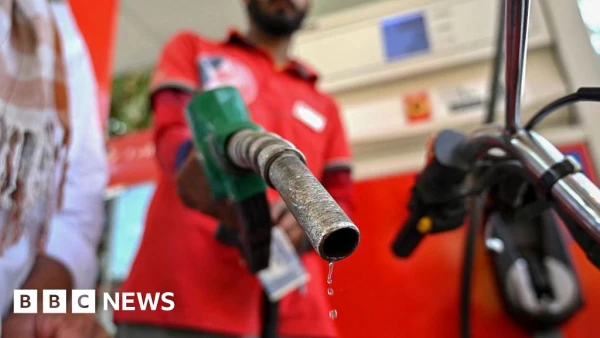
Oil prices climbed sharply on Monday after plans for a second round of peace negotiations between the United States and Iran stalled once again. Benchmark Brent crude rose by around 2% to $109.33 per barrel, while US-traded crude also increased by 2% to $96.78.
President Donald Trump revealed on Saturday that Washington had canceled plans to send a team to Pakistan for talks with Iranian officials, citing "tremendous infighting and confusion" within Tehran's leadership. "Nobody knows who is in charge, including them," Trump wrote on Truth Social. "Also, we have all the cards; they have none! If they want to talk, all they have to do is call!!!"
The stalemate has kept the vital Strait of Hormuz effectively closed due to the ongoing conflict, which has severely disrupted global energy supplies. Approximately one-fifth of the world's crude oil and liquefied natural gas typically passes through the waterway.
Iranian Foreign Minister Seyed Abbas Araghchi stated on Sunday that discussions with Oman, a neighbor along the strait, were ongoing. "Our focus included ways to ensure safe transit that is to benefit all dear neighbors and the world," he posted on social media. Araghchi also traveled to St. Petersburg on Monday for talks with Russian President Vladimir Putin, according to Iranian state media.
The surge in oil prices, which have risen more than 10% since Trump extended a ceasefire last week, is already affecting consumers. Sophie Huynh, a portfolio manager at BNP Paribas, warned that the ongoing closure of the strait could impact everything from "bin bags to medicine." "If the strait remains closed for more than a few weeks, the effects will be really far reaching in terms of supply chain," she told the BBC.
Traders are becoming more cautious, waiting for concrete evidence of a resolution before reacting further. "I think traders want concrete evidence rather than just a fragile and reversible ceasefire agreement," said Goh Jing Rong, an economics lecturer at Singapore Management University.
In the UK, the Bank of England is set to attend a government meeting on Tuesday to discuss the conflict's impact on living costs. Prime Minister Sir Keir Starmer noted that the economic consequences "could still be with us for some time," as rising fuel prices and potential energy bill increases loom.
Stock markets showed mixed reactions: London's FTSE 100 dipped 0.18%, while Asian markets closed higher, with Japan's Nikkei 225 rising 1.38% and South Korea's Kospi gaining 2.15%.