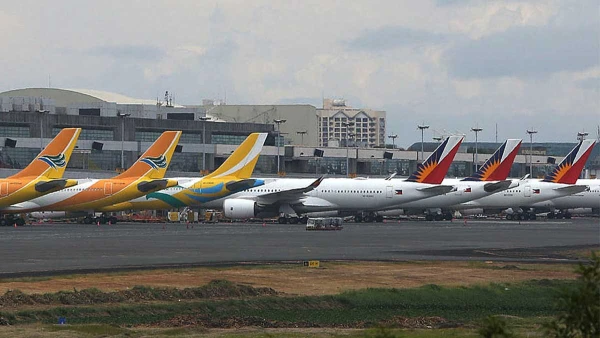
Airfares in the Philippines are expected to remain elevated in the first half of May, even as the Civil Aeronautics Board (CAB) lowered the fuel surcharge from Level 19 to Level 18. The reduction offers only marginal relief for travelers, with additional fees still more than five times higher than pre-Middle East crisis levels.
From May 1 to May 15, passengers will pay an extra P593 to P1,734 for domestic flights and P1,958.44 to P14,561.87 for international flights, on top of base fares. This is a slight decrease from the Level 19 surcharge applied from April 16 to April 30, which ranged from P627 to P1,834 domestically and from P2,070.77 to P15,397.15 internationally.
Despite the dip, the surcharge remains near the maximum allowable Level 20, reflecting ongoing volatility in global fuel markets. Cebu Pacific CEO Mike Szucs said he expects fuel prices to ease only by the third quarter of 2026, noting that supply is not currently an issue. Both Cebu Pacific and Philippine Airlines have secured enough jet fuel supply through end-June.
"Clearly, we've got a few months to go through where we've got to manage incredibly inflated fuel prices," Szucs said. "It's our largest cost … and now, of course, it's gone up by more than double."
The slight easing in the surcharge mirrors a parallel decline in global jet fuel prices, which averaged $184.63 per barrel in the week ending April 17, down from a peak of $209 per barrel in early April. However, prices remain far above prewar levels below $100 per barrel. A fragile truce among Iran, Israel, and the US is in place, but peace talks mediated by Pakistan remain stalled.
Before the Middle East conflict erupted, airlines operated under a Level 4 surcharge, with domestic fuel fees of P117 to P342 and international surcharges of P385.70 to P2,867.82.