Economic cycles don't conclude simply because we grow weary of them. They end when excesses have been purged and capital stands ready to become productive once more.
For over a decade, the Philippine economy has been lauded for its resilience, consumer strength, and relative insulation from global turbulence. Yet resilience should not be mistaken for immunity. Beneath the surface, familiar historical patterns are reemerging—patterns documented repeatedly in economic annals.
One framework for understanding this moment is the Kondratieff Cycle, a long-term economic model spanning 40 to 60 years. First proposed by Russian economist Nikolai Kondratieff in 1925, this cycle suggests economies progress through multi-decade phases of expansion and contraction, driven by technological innovation. The phases are often metaphorically described as spring (expansion), summer (maturity), autumn (stagflation), and winter (recession/depression). These are not quarterly fluctuations but fundamental regimes.
A Historical Echo
Following World War II, the Philippines entered its spring—a period of reconstruction, institutional rebuilding, and demographic momentum. The summer phase arrived in the 1970s, characterized by aggressive, debt-financed expansion. When external conditions tightened, winter descended in the 1980s, manifesting as a balance-of-payments crisis and political upheaval.
The reforms and liberalization of the 1990s sparked a new spring, which matured into a prolonged autumn lasting nearly three decades. This era saw steady growth, rising asset prices, and deepening financial markets. However, it was also a period where leverage quietly supplanted productivity as a primary engine of returns—a substitution with significant implications today.
Markets Signal a Shift
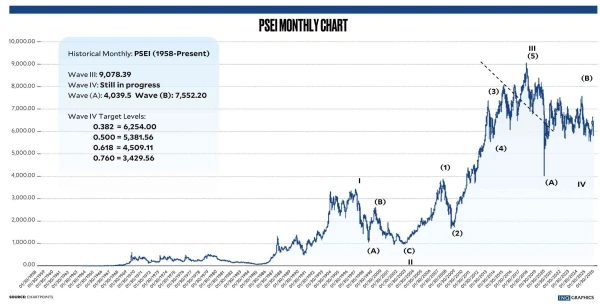
Markets often act as leading indicators, rarely waiting for official confirmation. The Philippine Stock Exchange Index (PSEi) has spent years consolidating rather than compounding. Valuations have compressed even as corporate earnings recovered from the pandemic. Recent rallies have been shorter, market leadership narrower, and investor patience thinner.
The Philippine peso tells a similar story. Each episode of depreciation is treated as temporary, yet subsequent recoveries grow progressively shallower. This behavior reflects not panic, but repricing—capital demanding higher compensation for risk in a late-cycle environment.
Technical analysts might interpret this through frameworks like the Elliott Wave Principle, which views markets as expressions of collective investor psychology. Whether seen as science or art, the core insight holds: optimism expands in impulses, while realism asserts itself in corrections. Both Philippine equity and currency markets are exhibiting the classic signs of an economy transitioning from autumn to winter.
Unresolved Issues Resurface
The underlying challenges now resurfacing were never fully resolved, merely deferred. As the long economic autumn wanes, the nation faces the return of unresolved structural issues, testing the foundation built during decades of growth.