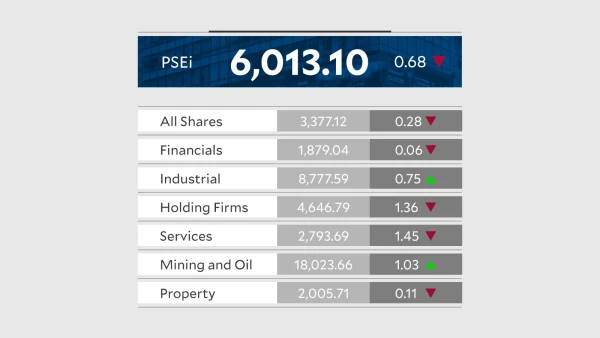
The Philippine Stock Exchange Index (PSEi) continued its downward trajectory on Tuesday, April 14, 2026, closing at 6,013.10 after shedding 0.68 percent, or 40.95 points. Investor caution prevailed as escalating tensions in the Middle East and rising oil prices fueled fears of persistent inflation.
Market analysts pointed to the United States' blockade of the Strait of Hormuz as a key factor unsettling global markets. This geopolitical move has heightened concerns over potential oil supply disruptions, pushing commodity prices higher and clouding the economic outlook for import-dependent nations like the Philippines.
“Market sentiment was also weighed down by reports that the Philippines lags behind its ASEAN peers in the Foreign Direct Investment Confidence Index. Overall, cautious positioning prevailed as uncertainty continues to limit risk appetite,” noted Luis Limlingan, head of sales at Regina Capital Development Corp.
Trading activity reflected the prevailing wariness, with net value turnover reaching ₱5.65 billion—below the year-to-date average of ₱6.47 billion. Foreign investors continued to withdraw capital, recording net outflows of ₱446.77 million, which added further downward pressure on the main index.
Sectoral performance was mixed during the session. The mining and oil sector emerged as the sole bright spot, gaining 1.03 percent, likely buoyed by the rise in global oil prices. In contrast, the services sector led the decliners, falling 1.45 percent.
Individual stock movements highlighted the divided market. Monde Nissin Corp. was the top performer among index members, surging 6.73 percent to ₱6.98 per share. Conversely, DigiPlus Interactive Corp. faced significant selling pressure, dropping 5.39 percent to ₱15.80.
Despite the index's decline, market breadth showed a slight positive tilt, with 110 advancing issues outnumbering 93 decliners. Analysts anticipate that investor sentiment will remain fragile in the near term, with market direction heavily influenced by ongoing geopolitical developments and fluctuations in global commodity prices.