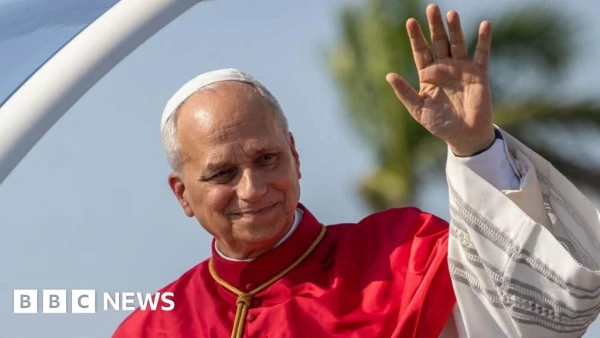
Pope Leo has clarified that his recent speech criticizing "tyrants" who spend billions on warfare was not intended as a direct response to U.S. President Donald Trump, despite the timing following a public spat between the two leaders.
Speaking to reporters aboard a flight to Angola on Saturday, the pontiff explained that the remarks were written two weeks prior—"well before the president ever commented on myself." He emphasized, "And yet as it happens, it was looked at as if I was trying to debate, again, the president, which is not in my interest at all."
The controversy stems from a speech the Pope delivered in Cameroon on Thursday, where he condemned leaders who "turn a blind eye to the fact that billions of dollars are spent on killing and devastation, yet the resources needed for healing, education and restoration are nowhere to be found." He added, "The masters of war pretend not to know that it takes only a moment to destroy, yet often a lifetime is not enough to rebuild." The speech also addressed an "endless cycle of destabilisation and death" in a conflict-ridden region of Cameroon.
These comments were widely interpreted as a veiled critique of Trump, who had launched a scathing attack on the Pope earlier in the week. On Monday, Trump labeled the first American Pope as "terrible for foreign policy" and "WEAK on crime," following the pontiff's expressed concerns over Trump's threats regarding Iran and the Strait of Hormuz. Trump later remarked, "The Pope can say what he wants, and I want him to say what he wants, but I can disagree," and shared an AI-generated image depicting himself in a Christ-like manner, which he subsequently removed.
Pope Leo attributed the misinterpretation to "a certain narrative that has not been accurate," fueled by "the political situation created" by Trump's comments. He is currently on a major tour of Africa, visiting 11 cities across four countries, highlighting the growing significance of Catholicism on the continent, which is home to over 288 million Catholics—more than a fifth of the global Catholic population.