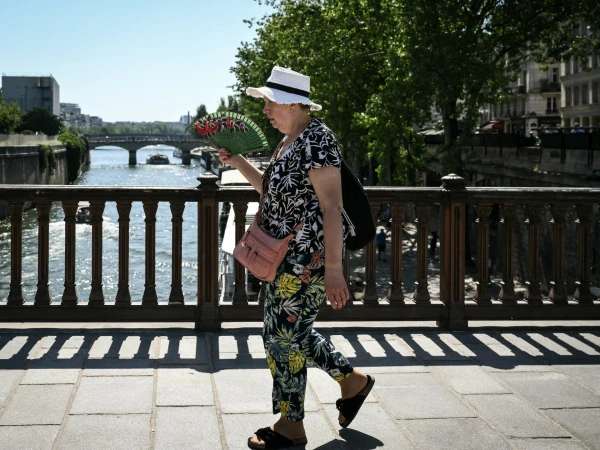
Italy’s Ministry of Health declares red heatwave alert in 16 cities, including Milan and Rome, as schools close in UK.
Much of Western Europe is in the grip of a sweltering heatwave that has smashed temperature records in many countries and left tens of thousands of people without power in France.
The extreme weather is being driven by atmospheric and circulation patterns that keep hot air trapped in place for days, causing the mercury to slowly rise, as global warming exacerbates these factors, experts said.
Recommended Stories
list of 4 items
- list 1 of 4Europe heatwave scorches cities and wildlife
- list 2 of 4France records hottest-ever day as 40 drown trying to escape heatwave
- list 3 of 4Deadly heatwave grips Europe as temperatures soar across continent
- list 4 of 4Nearly all children globally exposed to at least one climate hazard: Report
end of list France’s national temperature indicator – an average of daytime and nighttime temperatures across 30 stations – reached 29.8 degrees Celsius (85.64 degrees Fahrenheit) on Tuesday, the hottest since measurements began in 1947.
The heatwave caused the country’s first major power outage of this latest bout of extreme weather after a heat-related incident with a transformer left about 68,000 households on Wednesday without electricity in the northwestern department of Finistere, authorities said.
While teams worked through the night to fix the issue, which took place late on Tuesday, power is not expected to be restored in full until the end of Wednesday at the earliest.
Up to 106,000 clients of the French power network were left without power by late Tuesday as the scorching temperatures strained infrastructure built before man-driven climate change made heatwaves longer, more frequent and more intense, according to scientists.
Sales of fans and air conditioners, meanwhile, skyrocketed in a country where most buildings are not designed to deal with extreme heat.
Added to the 31 departments currently on orange alert, more than 90 percent of the French population is exposed to extreme heat with temperatures of 39C to 41C (102.2F to 105.8F) expected on Wednesday from Brittany to Paris and in much of the southwest.
At least 48 people have died in France from drowning as they attempted to seek respite from the crippling heat, while two young children were killed by heat in a car, authorities said.
In the United Kingdom, the Met Office weather agency issued a heat warning for Wednesday and Thursday with forecasts suggesting June’s all-time daily temperature record could be broken.
Get instant alerts and updates based on your interests. Be the first to know when big stories happen.
The “red” heat health alert for much of central and southern England, as well as Wales, is only the second such warning ever issued by UK authorities. The first was in July 2022, when temperatures exceeded 40C (104F).
The peak of the heatwave is now forecast for Wednesday and Thursday when highs could reach 39C (102.2F) in London or southern England.
“Red warnings are reserved for the most severe events and we’re expecting severe and significant impacts from this heatwave, with health impacts likely for many, even beyond those who are normally more vulnerable to the heat,” said Mark Sidaway, deputy chief forecaster for the UK Met Office.
Conditions are expected to ease by Friday, the Met Office said.
Some schools in England are closed due to the heat and many train services have been cancelled with passengers urged to avoid non-essential travel in areas covered by the red warning.
Eurostar said it cancelled four trains planned between London and Paris on Wednesday and Thursday “due to expected adverse weather.’’
Italy’s Ministry of Health declared a red heatwave alert in 16 cities on Wednesday, including Milan and Rome.
Eastern Europe to be hit next
In the coming days, the heatwave is expected to extend into Eastern Europe.
Poland’s weather service issued high-level heat warnings for the western part of the country from Thursday to Saturday, predicting that temperatures could break the record of 40.2C (104.4F) set in 1921.
Croatia’s popular Adriatic coast was also put under red alert for Friday and Saturday.
Hungary, already under a second-level heat alert, said it was raising that to the maximum level from Saturday to Tuesday as temperatures continued to rise.
Two elderly people died of heatstroke in Spain, which has experienced extreme temperatures since the weekend exceeding 40C.
Some relief could start to come in Spain on Wednesday when the country’s State Meteorological Agency said temperatures would drop in most of the country.
By Wednesday afternoon, only parts of the Basque country in the north will still be marked red, and on Thursday, no part of Spain will be rated either red or orange.
But no quick relief is in sight across the rest of Western Europe.
From Wednesday until at least Friday, the central and southern Netherlands will be under a code orange for extreme heat while Belgium has placed the entire country under an orange heat alert starting on Thursday as a record-breaking heatwave looms, according to the newspaper Le Soir.