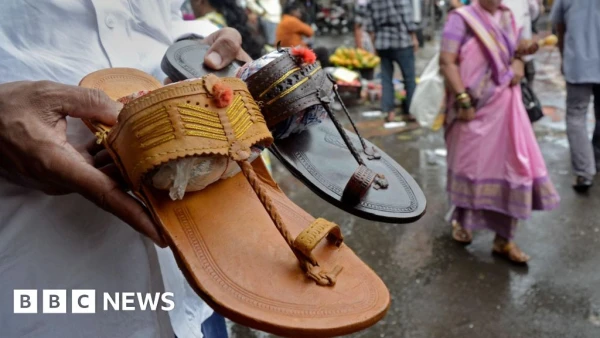
Italian luxury fashion house Prada has launched a limited-edition collection of sandals inspired by India's traditional Kolhapuri designs, nearly a year after being accused of cultural appropriation.
The new sandals, reportedly priced at €750 ($881; £650) per pair, are handcrafted by artisans in Maharashtra and Karnataka, the Indian states where the iconic Kolhapuri chappals originate. The move follows backlash Prada faced in June 2023 when it presented similar footwear at a Milan fashion show without acknowledging its Indian roots, simply labeling them as "leather sandals." The brand later conceded the design's heritage.
The collection is available at 40 Prada stores globally and online. Prada claims the line "combines traditional techniques with contemporary design and premium materials," fostering "a dialogue between Indian heritage and modern luxury expression."
In a further effort to mend relations, Prada announced a three-year training program for artisans from eight Indian districts known for Kolhapuri sandal production. Developed with two Indian design institutes, the program will train 180 artisans in six-month modules, with some participants potentially advancing to the Prada Group Academy in Italy.
Lorenzo Bertelli, Prada Group's head of corporate social responsibility, stated the initiative aims to "support artisans by strengthening skills, preserving traditional knowledge, and helping local communities sustain the craft." Tanu Kashyap, director general of the National Institute of Fashion Technology (one of the collaborating institutions), added that the program will also help promote traditional Indian crafts in global markets.
Kolhapuri sandals, named after the city of Kolhapur in Maharashtra, date back to the 12th century. Traditionally made from leather with natural dyes suited to hot climates, they received Geographical Indication (GI) status from the Indian government in 2019, certifying their regional authenticity. In India, they typically sell for between 500 rupees ($5.29; £3.91) and 1,000 rupees—a fraction of Prada's luxury price tag.
The incident highlights ongoing debates about the use of traditional designs by international brands, with concerns about limited recognition and returns for the original artisans.