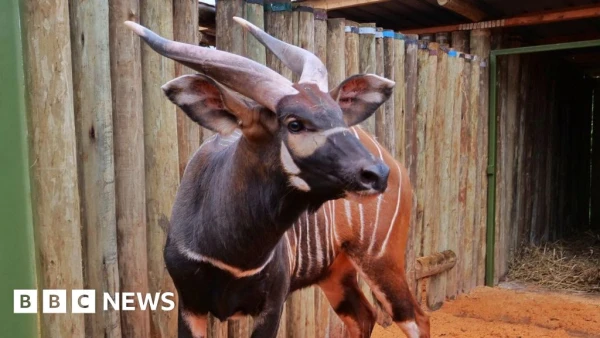
Four critically endangered mountain bongos have been flown from Prague Zoo in the Czech Republic to Kenya, marking a significant milestone in conservation efforts for the rare antelope species. The animals arrived at Nairobi's main airport on Tuesday night, greeted by Kenya's foreign and tourism ministers, before being transferred to a private wildlife reserve in central Kenya.
The Kenya Wildlife Service (KWS) hailed the event as a "historic homecoming" and a "meaningful step" toward restoring the species in the wild. Once numbering around 500 in the 1970s, fewer than 100 mountain bongos are believed to remain in their natural habitat—a number surpassed by those living in zoos worldwide.
KWS Director-General Erustus Kanga described the arrival as "a moment of hope, responsibility, and renewed commitment to securing the future of one of the world's rarest large mammals." The four males are expected to strengthen the gene pool by breeding with the existing population of 102 mountain bongos at the Mount Kenya Wildlife Conservancy (MKWC).
The mountain bongo is a large, chestnut-red antelope with narrow white vertical stripes and long spiral horns. Conservation efforts have focused on breeding and reintroducing them into the wild. Last year, about 17 mountain bongos were repatriated from the Rare Species Conservation Foundation in Florida, following earlier repatriations in 2004.
Before being released into the wild, the bongos undergo acclimatization and detailed monitoring to build immunity. Prague Zoo stated that the animals would be gradually integrated into MKWC's breeding program to enhance genetic diversity and produce viable offspring for future wild release. On Wednesday morning, KWS reported that the antelopes had arrived safely at the conservancy and were settling in under close care.
Kenya aims to boost the mountain bongo's wild population to around 700 by 2050 through a national recovery plan led by KWS. However, conservationists caution that reintroduction faces challenges, including tick-borne diseases, which have claimed some previously repatriated animals.