For decades, software developers have embraced methodologies like agile, test-driven development, code reviews, and CI/CD to improve code quality and productivity. A 2012 Google study found that fixing a bug during system tests is 1000x more expensive than fixing it at the unit testing stage, emphasizing the need for developers to write quality code from the start.
Generative AI-powered code generation promises to help developers deliver better code faster. Managed services like GitHub Copilot and Amazon CodeWhisperer have shown productivity gains, but they rely on closed-source models that can't be customized to an organization's technical culture and processes.
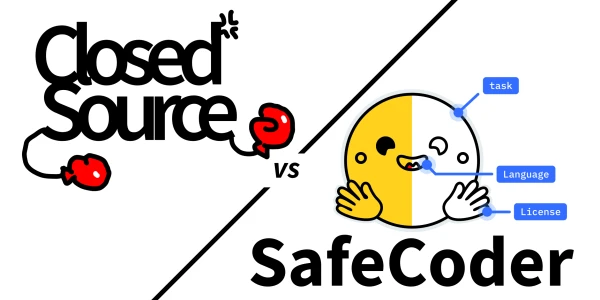
Hugging Face recently launched SafeCoder, an enterprise code assistant built on the open-source StarCoder models. SafeCoder offers state-of-the-art performance, transparency, customization, IT flexibility, and security. Here's how it stacks up against closed-source alternatives.
State-of-the-Art Models
SafeCoder is built on StarCoder, a 15.5 billion parameter model trained on over 80 programming languages. It uses Multi-Query Attention for improved throughput and latency, has an 8192-token context window, and supports fill-in-the-middle code insertion. As new models become available, SafeCoder will seamlessly upgrade. In contrast, closed-source services share no details about their underlying models.
Transparency
StarCoder was trained on 1 trillion tokens from The Stack, a 2.7 TB dataset of permissively licensed open-source code. Hugging Face provides a tool for repository owners to check if their code is included and honor opt-out requests. A research paper discloses the architecture, training process, and metrics. Closed-source services offer only vague descriptions and no public metrics.
Customization
StarCoder offers variants fine-tuned for specific languages (Python) or conversation-style coding. Hugging Face provides fine-tuning code on GitHub and can help enterprises train models on their own data and coding guidelines. This customization is impossible with closed-source services.
IT Flexibility
SafeCoder uses Docker containers for fine-tuning and deployment, running on-premise or in any cloud. It includes Optimum hardware acceleration libraries that optimize performance on CPUs, GPUs, or AI accelerators, giving enterprises control over cost and performance. Closed-source services are only available as managed services.
Security and Privacy
SafeCoder runs under the enterprise's complete administrative control, on-premise or in the cloud, and can operate fully air-gapped without an internet connection. It collects no telemetry or user data. Closed-source services rely on cloud security and may collect user engagement data, with varying opt-out options.
Conclusion
SafeCoder empowers enterprises with a customizable, transparent, and secure code assistant that leverages state-of-the-art open-source models. For organizations that prioritize data privacy and control over their development processes, SafeCoder is a compelling alternative to closed-source solutions.