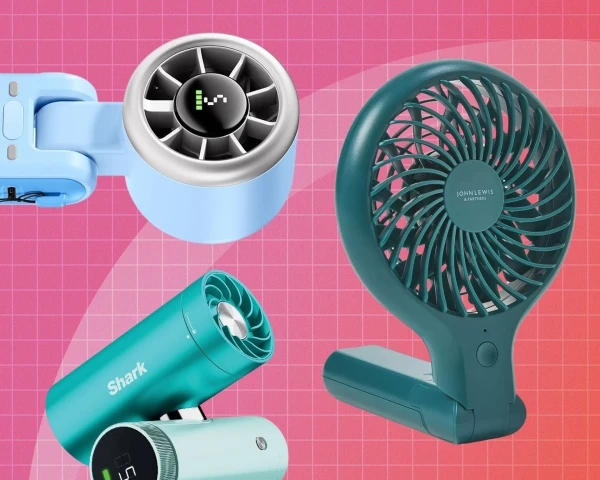
A nother month, another heatwave. The climate crisis means things are heating up year on year, and while we can hide in air-conditioned shops and offices, our homes can get uncomfortably – sometimes dangerously – hot.
We also have to go outside – or worse, pack ourselves like sweaty sardines on sweltering public transport. On those occasions, a portable fan can make all the difference between manageable discomfort and indulging in an inadvisable quantity of ice-cream. Their recent popularity has led to manufacturers churning out cheap-but-not-especially cheerful products that ultimately end up as clutter in your house – or worse, landfill, where an estimated 4.3m will end up this year alone.
So which should you buy to cool you for many summers to come? I’ve been testing handheld and neck fans from the likes of John Lewis, Dunelm, Dyson, Shark and Bush, assessing them for power, noise, battery life and portability. Here’s what I’ve found.
At a glance
- Best handheld fan overall:
John Lewis handheld and foldable fan – currently out of stock
- **Best budget handheld fan:**Fine Elements folding rechargeable mini travel fan – click and collect only
- **Best handheld fan for power:**Diveblues Jetforce
- Best neck fan:
Jialexin three-speed neck fan
- Best handheld fan for flexibility:
Shark ChillPill
Why you should trust me
I’ve been testing consumer technology for more than a decade now, including electric toothbrushes and water flossers for the Filter. Yet, without wanting to shatter the illusion that this makes me uniquely qualified for the task, portable fans are among the easiest things to test. There’s little subjectivity involved, as you can measure power, noise, weight and battery life. All you really need is a working hypothalamus and fingers that can manoeuvre buttons – which I have.
You also need hot weather, of course, and the Great British summer has been, if anything, a little too accommodating in that regard. It also helps that my PC can turn my tiny office into an overheated sauna in 20 minutes.
How I tested
Blown away: wind speed was tested by active use and with a digital anemometer. Photograph: Alan Martin/The Guardian
Each of the 16 fans I tested was assessed for measures that can be objectively tested. Power was not only measured by active use, but via a dedicated digital anemometer to measure wind speed at the highest and lowest supported speeds.
More power equals more noise, so I used a sound measurement app held 15cm from the source to assess the decibel level at high, medium and low speeds. I timed how long it took each fan to empty its battery at the lowest and highest speeds (a test my three cats hated even more than I did, due to the constant noise for hours at a time), and popped each one on the scale to get an idea of portability.
I also assessed them for more subjective things. Is the fan nice to hold? Can it be folded for increased portability or hands-free use? Does it look visually appealing?
Finally, there’s the biggie: price. With portable fans costing between £3 and £100+, there’s a huge range of options. It’s simplistic to suggest that a higher cost automatically equals a better experience, though there is naturally a correlation. Nonetheless, I’m more forgiving of odd quirks in cheap fans than I would be in more expensive ones.
There’s also the sticky issue of repairability and the growing waste problem of fast tech. Tough-to-replace lithium-ion batteries were present in all but two of the fans tested, which is far from ideal. With that in mind, I kept an eye on build quality too, hoping to endorse fans that will have a long and productive life before they need to be disposed of (electrical recycling, please – you can find a local spot here).
After testing, the fans were either returned to the manufacturer or donated to charity.
Here are the nine best portable fans from my tests.
The best neck and handheld fans in 2026
Photograph: Alan Martin/The Guardian
Best handheld fan overall:
John Lewis handheld and foldable fan
John Lewis
Handheld and foldable fan
£12
What we love
Competitively priced, decent power and comfortable to hold
What we don’t love
A slightly awkward shape for bagging
Photograph: Alan Martin/The Guardian
£12 at John Lewis Currently out of stock
It may not look that special, but John Lewis’s offering is a well-made product at a reasonable price that doesn’t put a blade wrong. The handle is a good size for a comfortable grip, and the sage colour my review unit came in is rather stylish. You can also get it in white, light blue or an eye-searing orange if you prefer.
Why we love itLooks and build quality aside, the fan provides what you need without fuss. It has three power settings, putting out between 2.5 and 3.7 metres a second (m/s) of wind speed, and the 10cm head covers your whole face at a sensible distance without needing constant adjustment. I measured a peak volume of 62.4dB, which isn’t the lowest, but is still quieter than some of the chunkier fans at their lowest levels.
The battery lasted more than four hours on its highest setting, which should be sufficient for most journeys, and it can be charged up via a USB-C cable when it’s empty. Pleasingly, the handle can also be folded down to make it a handy desktop fan with or without a cable attached. It works well, as long as you have space to keep it close enough to be refreshing.
**It’s a shame that …**at 25cm, it’s a little on the tall side.
**Power levels:**3
**Measuredair speed:**2.5-3.7m/s
Measured volume**:51.1-62.4dBTested battery life:**maximum, 4hrs 11mins; minimum, 9hrs 37mins
**Measured weight:**181g
John Lewis
Handheld and foldable fan
£12
What we love
Competitively priced, decent power and comfortable to hold
What we don’t love
A slightly awkward shape for bagging
Best budget handheld fan:
Fine Elements folding rechargeable mini travel fan
Fine Elements
Folding rechargeable mini travel fan
£6
What we love
Incredible value and nicely portable
What we don’t love
Questionable build quality
Photograph: Alan Martin/The Guardian
£6 at Wickes (click and collect only) Cheap and cheerful, this folding fan may feel a little rough around the edges, but it gets the job done. It’s not the cheapest fan I tested, but it proved superior to Dunelm’s £3 offering (which dropped to a barely noticeable 0.5m/s power as the AA batteries drained) and beat Superdrug’s £5 fan on battery life (a disappointing 45 minutes at maximum and two hours on minimum).
Why we love itIt’s flimsy, but the fan delivers the basics pretty well. It has three speeds, giving between 2.6 and 3.7m/s of wind speed, while the battery lasted six hours at the lowest setting, and just short of three at its highest.
It’s a touch noisier than the John Lewis model, maxing out at 64.8dB, but it’s more travel-friendly, folding in half for portability and weighing 48g lighter. That folding hinge means you can also use it as a desk fan, if you like, and there’s even a small flashlight on the bottom for looking around in the dark (though it’s easy to leave this on by mistake).
**It’s a shame that …**the build quality isn’t all that, with some rough plastic moulding.
**Power levels:**3
**Measuredair speed:**2.6-3.7m/s
Measured volume**:**54.3-64.8dB
**Tested battery life:**maximum, 2hrs 50mins; minimum, 6hrs
**Measured weight:**133g
Fine Elements
Folding rechargeable mini travel fan
£6
What we love
Incredible value and nicely portable
What we don’t love
Questionable build quality
Best handheld fan for power:
Diveblues Jetforce
Diveblues
Jetforce
£18.99
What we love
Impressive power at a competitive price
What we don’t love
It starts loud and gets louder
From £18.99 at Amazon If you want power for a reasonable price, then the Jetforce is the answer. Even at its lowest of five speeds, it narrowly betters the speeds of the two fans above by hitting a breezy 3.8m/s.
Why we love itA refreshing breeze even at the lowest settings, but when you’re really struggling with the heat, crank it up all the way to level five, and it hits a massive 6.6m/s.
In truth, you likely won’t need to max it out, and that’s just as well because the noise levels really pick up on the higher settings. Starting at an already noisy 66dB, put it all the way up to level five, and it reaches 74.3dB, about the level of a vacuum cleaner – a vacuum cleaner uncomfortably close to your ears. It’ll also hit the battery hard: at level 1, you can eke out nearly 11-and-a-half hours, but that drops to 2hrs 37mins on max.
Still, if you can cope with the noise or routinely wear headphones, it’s a nice option to have in really hot weather. Plus, the flexible head means you can use it as a desk fan, and it has an attachable lanyard so it can be worn around the neck, blasting air upwards.
**It’s a shame that …**it gets noisy fast.
**Power levels:**5
**Measured****air speed:**3.8-6.6m/s
Measured volume**:**66-74.3dB
**Tested battery life:**maximum, 2hrs 37mins; minimum, 11hrs 25mins
**Measured weight:**184g
Diveblues
Jetforce
£18.99
What we love
Impressive power at a competitive price
What we don’t love
It starts loud and gets louder
Best neck fan:
Jialexin three-speed neck fan
Jialexin
Three-speed neck fan
£28.99
What we love
Impressive cooling of the neck
What we don’t love
A fan pointed at the ears gets grating
Photograph: Alan Martin/The Guardian
£28.99 at Amazon Want something hands-free to keep you cool? A fan worn around the neck does that, while targeting the body’s thermoregulation centre, which can, in theory, make you feel cooler.
The Jialexin three-speed neck fan certainly delivered that, if you can cope with fans running so close to your ears.
Why we love itIt really does make you feel cooler, even if the fans don’t appear to be more powerful when compared with regular handheld fans. My anemometer test revealed seemingly low speeds of 1.7 to 2.2m/s, but there are more air sources and, as a result, the cooling effect felt more consistent and less disruptive than a jet of constant air to the face.
The downside of this, however, is the noise. While the measured volume of 52 to 64.1dB doesn’t sound too bad – around the sound of a busy office – having it this close to your ears for an extended period is tiring, and you do feel a sense of calm when it’s switched off again. That said, if you’re wearing headphones, it becomes a non-issue.
This neck fan is extremely comfortable to wear, and it’s more flexible than solid plastic ones, so you can shape it around your neck for more comfortable cooling. That, for me, makes it stand out from its competitors.
**It’s a shame that …**by design, neck fans have to be quite close to your ears.
**Power levels:**3
**Measured****air speed:**1.7-2.2m/s
Measured volume**:**52-64.1dB
**Tested battery life:**maximum, 3hrs 19mins; minimum, 8hrs
**Measured weight:**291g
Jialexin
Three-speed neck fan
£28.99
What we love
Impressive cooling of the neck
What we don’t love
A fan pointed at the ears gets grating
Best handheld fan for flexibility:
Shark ChillPill
Shark
ChillPill
from £129.99
What we love
Three heads for flexible cooling
What we don’t love
More heads means more to carry around
Photograph: Alan Martin/The Guardian
£129.99 at SharkNinja£129.99 at Wayfair Shark’s first-ever portable fan brings plenty of innovation to the table. The ChillPill has three interchangeable heads, letting you swap out the familiar blast of air for one with water misting or a cold plate for direct skin cooling. At £129, it’s the priciest fan on this list, but its flexibility is impossible to beat.
Why we love itWhile it’s not the most powerful fan you’ll find here, it’s still one of the most effective at quick cooling thanks to the two alternative heads. The misting head is extremely refreshing, with a spritz of water accompanying the airflow for more impact – even if the tiny reservoir means you’ll be refilling it frequently. The cold plate, meanwhile, gives the feeling of pressing an ice-cold bottle against your forehead or neck on a hot day – only it stays cool for as long as the battery lasts.
On that note, I found Shark’s battery life estimates wildly inaccurate, but not in the way you’d expect. While the manual says you’ll get “up to 10 hours” with the fan on its lowest setting, I was half asleep when it conked out at 2am, nearly 20 hours after kicking off the test. The cold plate’s promised two hours actually ended up at more than nine, making this a great accompaniment for all-day trips.
It’s a shame that …£129.99 is a big ask, and if you bought every extra accessory, you’d be down another £96.94.
**Power levels:**10 (2 for cooling plate)
Measured air speed: 1.6-4.6m/s
**Measured volume:**46.2-74.1dB
**Tested battery life:**maximum, 2hrs 46mins; minimum, 19hrs 19mins(fan mode)
**Measured weight:**237g (with fan head; 253g for misting; 282g for cold plate)
Read the full Shark ChillPill review
Shark
ChillPill
from £129.99
What we love
Three heads for flexible cooling
What we don’t love
More heads means more to carry around
The best of the rest
Photograph: Alan Martin/The Guardian
JisuLife Handheld Fan Ultra2
JisuLife
Handheld Fan Ultra2
from $83.99
What we love
Incredible power and versatility
What we don’t love
It’s bulky, noisy and expensive
Photograph: Alan Martin/The Guardian
$83.99 (about £62.74) at JisuLife£93.49 at Amazon **Best for:**a multi-function fan
If you’ve got money to burn, then the JisuLife handheld fan Ultra2 is both ridiculously powerful and extremely versatile.
Starting with the power, it has 100 different speeds, ranging from 2.8m/s all the way up to 9.8m/s at full blast, with 98 increments in between. The battery is impressive too, lasting well over a day at the lowest speed – though this did drop to 1hr 34mins when running at full blast.
I was secretly quite pleased about that, as the 88.8dB volume (similar to a hairdryer) wasn’t a particularly fun time for my ears, even from a decent distance away. In truth, that kind of power is uncomfortably like staring down a wind tunnel anyway, and the lower settings are considerably easier on the ears: 59.5dB at level 1, rising to 79.1dB at 50.
The high price of entry is made a little easier to swallow, though, since the Ultra 2 brings a few extra features for the money. There are a couple of adapters in the box to turn the fan into an air cushion inflater pump or to help kickstart campfires by pushing in more air. A powerful torch on the back can flick between different lighting modes, including a flashing one to attract attention in an emergency.
For those of us allergic to camping, there are more sedate indoor uses. One of the adapters is a dust cleaner, which has removed an unspeakable amount of gunk from my keyboard, and the USB-C charging port is two-way, meaning you can steal some of the 9,000mAh battery for your other devices too.
**It didn’t make the final cut because …**you could buy 15 Fine Elements fans for the Jisulife’s RRP of £95.
**Power levels:**100; **measured****air speed:2.8-9.8m/s; measured volume:**59.5-88.8dB; **tested battery life:**maximum, 1hr 34mins; minimum, 26hrs 49mins; **measured weight:**294g
JisuLife
Handheld Fan Ultra2
from $83.99
What we love
Incredible power and versatility
What we don’t love
It’s bulky, noisy and expensive
VonHaus handheld fan and phone holder
VonHaus
Handheld fan & phone holder
from £10.99
What we love
Even at its fastest, it’s not aggressively loud
What we don’t love
Its smaller head weakens coverage somewhat
Photograph: Alan Martin/The Guardian
£10.99 at VonHaus£10.99 at Amazon Currently out of stock
Best for: peace and quiet
Take it from someone who’s listened to the incessant hum of fans for weeks now: the noise can become grating. If keeping sound to a minimum is your priority, then this VonHaus 3-in-1 fan might be the one for you. At its lowest setting, it registered just 41dB – less than the sound of a fridge humming.
At that volume, you’re looking at a limited power of 2.7m/s, of course, but you can increase that to 4.3m/s over five incrementally louder settings if you need something more. It’s worth noting that by the time you hit maximum, the volume reaches 61.9dB – more comparable with the other fans on test.
Overall, it’s a well-designed fan: comfortable in the hand, with a stand to put it upright on your desk, including a phone holder at the base if you want to watch something over the fan’s whisper. You can even use it as a makeshift neck fan with the detachable lanyard and the head pointed upwards. This isn’t a direct substitute for a neck fan, as it’s still aimed at the face, but it’s a nice added use case all the same.
**It didn’t make the final cut because …**the smaller head doesn’t cover quite as much of the face as other models.
**Power levels:**5; **measured****air speed:2.7-4.3m/s; measured volume:**41-61.9dB; **tested battery life:**maximum, 3hrs 45mins; minimum, 13hrs 20mins; **measured weight:**129g
VonHaus
Handheld fan & phone holder
from £10.99
What we love
Even at its fastest, it’s not aggressively loud
What we don’t love
Its smaller head weakens coverage somewhat
Dyson HushJet Mini
Dyson
HushJet Mini
from £99
What we love
Incredible power from such a tiny product
What we don’t love
Incredible noise from such a tiny product
Photograph: Alan Martin/The Guardian
Gadcet link OOS so swapped for Amazon TK
£99.99 at Downtown Stores£99 at Amazon Best for: rapid cooling
Dyson’s first handheld fan has plenty going for it. The company says it’s taken “17 years of airflow expertise” to pack so much power into a device so small. And the volume of air it can push out is genuinely impressive, with my anemometer measuring 6.1m/s at the highest of its five levels.
The HushJet’s biggest problem is the name. Put the word “hush” in a product name, and it’s not unreasonable to expect whisper-quiet performance. And while it makes less racket than experienced hardware engineers would dream possible, it’s still incredibly loud for most, with volumes ranging between 61.5dB on level 1 and 76.2dB on level 5. That’s between the volume of a dishwasher and a vacuum cleaner – neither of which you’d want close to your ears for extended periods. For context, the USNational Institute for Occupational Safety and Health recommends hearing protection for extended exposure to volumes over 85dB.
If you can get past the noise, there’s no doubting its cooling capabilities, especially if you engage boost mode. This setting requires you to hold down the “speed up” button and puts out an even more impressive 7.5m/s of wind speed (at an even noisier 80.3dB). It will eat through the product’s middling battery (which is already less than an hour for constant level-5 use), but it will rapidly bring down the temperature.
**It didn’t make the final cut because …**it’s more jet than hush.
**Power levels:**five plus boost mode; **measured air speed:**2.0-6.1m/s (7.5m/s in boost mode); **measured volume:**61.5-76.2dB (80.3dB in boost mode); **tested battery life:**maximum, 51mins; minimum, 6hrs 9mins; **measured weight:**220g
Read our full Dyson HushJet Mini review
Dyson
HushJet Mini
from £99
What we love
Incredible power from such a tiny product
What we don’t love
Incredible noise from such a tiny product
Aecooly neck fan Click 01
Aecooly
Neck fan Click 01
from £15
What we love
Surprising power from a compact fan
What we don’t love
It looks like a panic alarm
$21.99 (about £16.43) at Aecooly£15 at eBay Best for: neck cooling
Most neck fans look like the inflatable pillows seen on long-haul flights. However, the Aecooly neck fan Click 01 is far less intrusive and a whole lot lighter. You can either hang the 94g, 3.2 x 6.1 x 7.5cm block around your neck, or keep the magnetic lanyard under your shirt and clip the fan to the front, keeping part of the neckband visible. The latter method minimises the “panic alarm” look, but it’s still not exactly unobtrusive, despite the heroic efforts of the lifestyle photographers on its product page.
It can blast a decent amount of air upwards, with my anemometer measuring speeds of up to 3.4m/s, although noise levels can be a little intrusive for something that’s permanently close to your ears. Battery life is decent, and it should go for at least two hours – or more than 10 if you use it on its lowest setting.
While advertised as a neck fan, it can be handheld too. Just unclip it from the magnetic lanyard attachment and you’ve got yourself a pretty competent handheld unit for more targeted cooling – albeit one that’s not much use hands-free thanks to its unusual shape.
**It didn’t make the final cut because …**despite being labelled as a neck fan, it doesn’t offer all-round neck cooling like rival models.
**Power levels:**three; **measured air speed:**2.1-3.4m/s; **measured volume:**59-71.4dB; **tested battery life:**maximum, 2hrs 15mins; minimum, 10hrs 37mins; **measured weight:**127g with lanyard (94g without)
Aecooly
Neck fan Click 01
from £15
What we love
Surprising power from a compact fan
What we don’t love
It looks like a panic alarm
What you need to know
Higher fan speeds might make you feel cooler, but they can be louder and drain the battery more quickly. Photograph: Alan Martin/The Guardian
What features should I look for in a fan?
Look out for fans with different uses. While the traditional way to use a handheld fan is, of course, in the hand, some models can double as desktop fans, either by folding in half or with a bundled stand. Some even come with a lanyard attachment so they can be worn hands-free around the neck.
While power might seem like the key feature, remember this is always a trade-off. Higher fan speeds will make you feel nominally cooler, but will come at the expense of battery life and noise levels.
What are the advantages of a neck fan?
Neck fans have two advantages over regular handheld fans. The first is that they’re entirely hands-free, meaning you can wear them without temporarily losing the use of a hand in the process.
The second advantage is that as they target the neck, there’s evidence to suggest they may make you feel cooler overall. This is because the thermoregulation centre is at the base of the brain, so a neck fan may make you feel cooler than a regular handheld one, even if your actual body temperature isn’t dropping all that much.
The downside to this is that the positioning directly below your ears can be a little tiring, given the constant volume (although this is a problem that’s easily sidestepped with a pair of headphones).
How do I dispose of an old handheld fan?
If your fan still works, you should try and pass it on to a friend or family member. After all, who would turn down free cooling in this heat? If none want it, someone on Freecycle might, or you may even be able to get some money for it on Gumtree or Facebook Marketplace.
If it’s broken, that’s a different story. Unfortunately, most handheld fans don’t have user-replaceable batteries, but it’s worth checking to make sure that’s the case with yours. Shark, for example, sells a replacement battery for the ChillPill.
If the fan can’t be fixed, then don’t dispose of it in your regular household waste, as the built-in batteries are both dangerous and an environmental hazard.
Some shops such as Currys will recycle electrical items free of charge. Alternatively, can find a list of local options on the Recycle Your Electricals website. Just enter your postcode and select “electric fan” from the list to see your local options.
Searching for more ways to keep cool? Read the best evaporative air coolers and our review of the Dyson HushJet Mini Cool fan
Alan Martin is a writer who has been putting products – including phones, gaming devices and wearables – through their paces for more than a decade. He is constantly tripping over product boxes