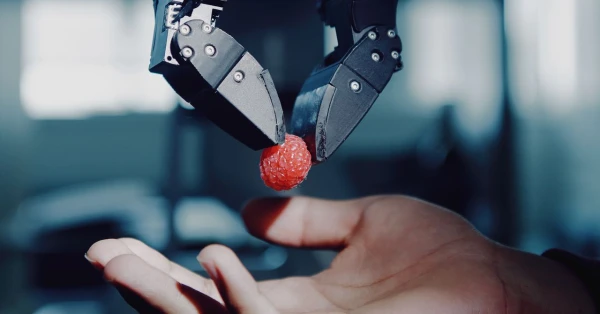
After years of watching robots fumble in labs and factories, a new robotic claw from the startup Eka has caught my attention. It doesn't just grasp objects—it adapts, searches, and learns from failure in a way that feels eerily natural.
In a recent demonstration, I watched the claw hurtle toward a light bulb on a table. I braced for the inevitable crunch. Instead, the claw decelerated at the last moment, then began patting the tabletop like someone fumbling for their glasses in the dark. It gently nudged the bulb between two pincers. The bulb rolled away. The claw chased it, took a few more attempts, and finally secured a grip. Seconds later, it smoothly screwed the bulb into a socket and lit up the workspace.
What makes this different from previous robot achievements is the underlying software. Eka's system uses a new type of AI model trained on millions of grasping attempts, both simulated and real. The result is a robot that doesn't follow rigid instructions but reacts to the physical world with a degree of dexterity and problem-solving that was previously the domain of science fiction.
While today's task was screwing in a light bulb, the implications are much broader. Eka envisions robots that can sort chicken nuggets in a fast-food kitchen, handle fragile items in a warehouse, or assist in assembly lines where parts vary slightly. It's a glimpse of what happens when large-scale neural networks meet the messy, unpredictable physical world.
For years, I've covered robots that can run, jump, and even do backflips. But this one feels different. It's not about raw power or speed—it's about touch, adaptation, and the quiet triumph of a machine that learns to handle a light bulb without breaking it.