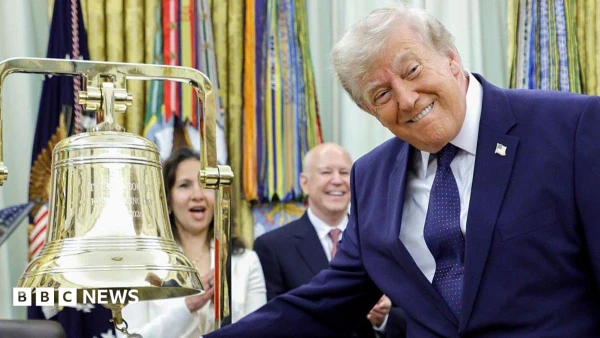
The launch of Trump Accounts, a new savings scheme designed to encourage investing among American children, was marked by President Trump ringing the Wall Street opening bell from the Oval Office this week. The accounts are now available to all U.S. children under 18, with newborns between 2025 and 2028 receiving a $1,000 initial contribution.
However, skepticism remains about whether the initiative will succeed in broadening access to the stock market. Critics argue that the plan is overly complex and may primarily benefit wealthier families, while lower-income households could face penalties and may not fully benefit.
How Trump Accounts Work
Trump Accounts are named after the president and can be opened for any child under 18 with a valid Social Security number. Parents can sign up via a mobile app. Family, friends, and employers may contribute up to $5,000 per year per child, with funds accessible when the child turns 18.
The money must be invested in a low-cost index fund designed for long-term growth. While it grows tax-free, withdrawals are taxed and subject to a 10% penalty if taken before age 59½, unless used for higher education, a first home purchase, or emergency expenses. The accounts are a variation of traditional IRAs, according to a Congressional report.
Mixed Reactions
The White House argues the accounts give millions of children a stake in the stock market, which has historically been "unevenly distributed." But critics like Will McBride of the Tax Foundation call the scheme too complicated, predicting only "relatively well-off" families will participate.
Andy Blocker of Edward Jones views the $1,000 starting subsidy as a valuable "on-ramp" for families new to investing. Yet Adam Michel of the Cato Institute warns the accounts may "not live up to the rhetoric," noting that lower-income families might withdraw funds early and incur penalties.
Early Sign-ups and Projections
About six million families had signed up before the July 4 launch, a fraction of eligible children. The White House reports that $1,000 subsidies have been deposited into over half a million accounts so far. By the end of the first week, families had contributed nearly $125 million.
Projections estimate that a $1,000 initial deposit could grow to $6,000 by age 18 without further contributions, based on historical S&P 500 returns. With $250 added annually, the pot could reach $19,000; with maximum contributions of $5,000 a year, it could be as high as $271,000.