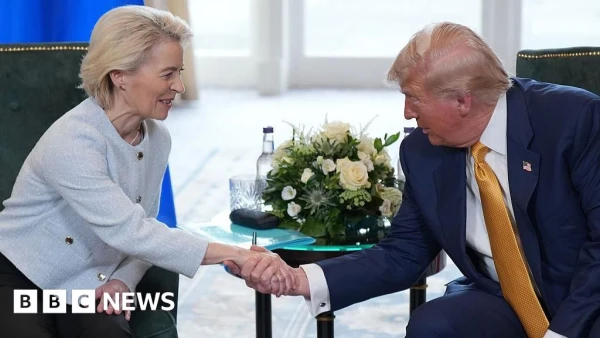
Donald Trump has announced a sharp increase in tariffs on cars and trucks imported from the European Union, raising them to 25% in a major escalation of trade tensions between the US and Brussels.
The US president accused the EU of failing to comply with the terms of a previously agreed trade deal, though he did not provide specific details. In a post on Truth Social, Trump stated, "I am pleased to announce that… next week I will be increasing Tariffs charged to the European Union for Cars and Trucks."
The European Commission responded by saying it would keep its options open to protect EU interests. The Commission claimed the EU was adhering to its commitments but would seek clarity from the US regarding its own obligations.
By targeting the automotive sector, Trump has hit a particularly sensitive area, as car manufacturing is a cornerstone of Europe's economy. The move comes less than a year after the EU and US reached a deal at Trump's Turnberry golf course in Scotland, which set levies on most European goods at 15%. That agreement provided a reprieve from the 30% tariffs Trump had previously threatened as part of his "Liberation Day" tariffs. In exchange, Europe agreed to invest in the US and take steps to boost American exports.
However, tensions have mounted over Trump's threats to annex Greenland, a self-governing Danish territory, leading the European Parliament to temporarily suspend approval of the trade deal in January. The deal was eventually approved in March, but with a clause allowing suspension if the US administration was found to have undermined the agreement's objectives or threatened EU member states' territorial integrity.
Since then, talks have stalled over disputes on steel and aluminium tariffs, with major European economies like Germany and France rejecting US proposals to adjust tariffs on a wide range of goods.
The European Commission reiterated its commitment to a "predictable, mutually beneficial transatlantic relationship," but warned it would defend its interests if necessary.
When asked to elaborate on how the EU had failed to adhere to the deal, Trump did not provide specifics, telling reporters, "We have a trade deal with the European Union. They were not adhering to it. So I raised the tariffs on cars and trucks."
Trump also urged European carmakers to shift production to the US, stating that if they produce in American plants, there would be no tariffs.
Bernd Lange, chair of the European Parliament's international trade committee, criticized Trump's actions, calling them "unacceptable" and saying they demonstrate "just how unreliable the US is as a trading partner." He noted that the European Parliament was drafting necessary legislation and aimed to finalize it by June.
Trade expert Professor Simon Evenett from IMD Business School commented that those who doubted the US administration's ability to stick to deals would feel vindicated, though he noted that social media posts are not law and Brussels would examine the fine print before deciding how to respond.
The tariffs on cars fall under a different legal process than Trump's Liberation Day tariffs, which were recently ruled illegal by the Supreme Court, meaning they are not affected by that ruling.