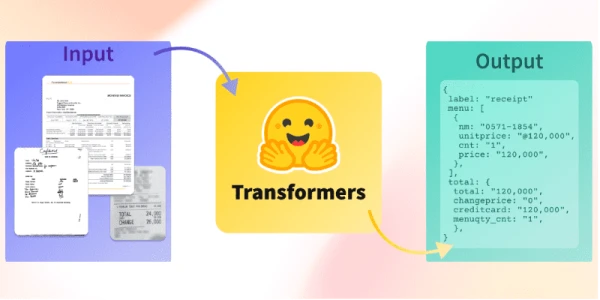
Enterprises often have vast amounts of knowledge trapped in documents like invoices, forms, and reports. Advances in text, vision, and multimodal AI now make it possible to extract and digitize this information. This guide explores how teams can leverage free, open-source models to build custom document AI solutions.
Document AI encompasses a range of tasks, including image classification, image-to-text conversion, document question answering, table question answering, and visual question answering. We'll cover common use cases, licensing considerations, data preparation, and modeling approaches, with links to demos and models.
Use Cases
There are at least six general use cases for Document AI, often requiring a combination of techniques.
Optical Character Recognition (OCR)
OCR converts typed, handwritten, or printed text into machine-readable text. Tools like EasyOCR and PaddleOCR offer document-level OCR, while TrOCR handles single-line text. Combining CRAFT for text detection with TrOCR yields accurate results. Key metrics include Character Error Rate (CER) and word-level precision, recall, and F1.
Document Image Classification
Sorting documents into categories (e.g., invoice, form) can benefit from multimodal models like LayoutLM and Donut, which use both text and visual layout. For instance, LayoutLMv3 achieves 95% accuracy on the RVL-CDIP benchmark, significantly outperforming text-only BERT models.
Document Layout Analysis
This task identifies document components such as headers, text blocks, and tables. Models like LayoutLMv3 and DiT treat it as object detection, achieving high mAP scores on benchmark datasets like PubLayNet.
Document Parsing
Extracting key-value pairs from forms or invoices, LayoutLM family models excel here. On the FUNSD dataset, LayoutLM raises F1 scores from 60% (BERT) to 90%.
Getting Started
Open-source models from Hugging Face provide a strong foundation for these tasks. With proper data preparation and model selection, organizations can build powerful document AI pipelines without vendor lock-in.