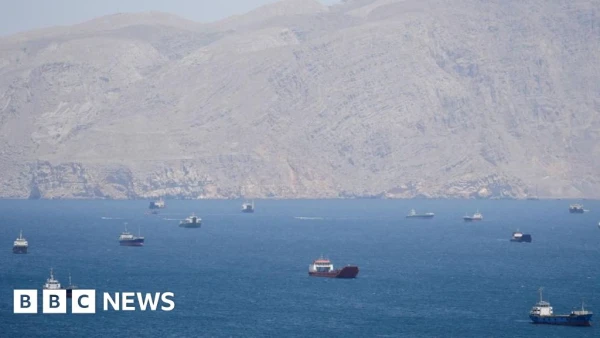
The United States has issued a stark warning to shipping companies: paying Iran for safe passage through the Strait of Hormuz could result in sanctions. The alert, released on Friday by the US Office of Foreign Assets Control (OFAC), emphasizes that US persons and companies are generally prohibited from making payments to Iranian government entities, and non-US persons may also face sanctions exposure for such payments.
OFAC stated, "Maritime industry participants involved with vessels calling at Iranian ports face significant sanctions risk under multiple sanctions authorities targeting Iran's shipping sector and ports."
Since the conflict began in February, Iran has severely restricted traffic through the strategic Strait of Hormuz—a vital channel for global oil and goods. The US has likewise enforced a naval blockade on Iranian ports. Tehran has labeled the interception of ships bound for or leaving Iranian ports as "piracy."
Iran claims it has collected tolls from vessels to ensure free navigation through the strait. Hamidreza Haji Bababei, deputy speaker of Iran's Parliament, asserted last week that the first toll revenue had been deposited with Iran's Central Bank, though no details on the amount, collection method, or payer were provided. The BBC could not independently verify this claim.
OFAC's alert specified that payments could include cash, digital assets, offsets, informal swaps, or in-kind payments such as charitable donations or payments at Iranian embassies. The agency warned that non-US persons making such payments could also face civil and criminal enforcement if the payments cause US persons—like insurers or financial institutions—to violate sanctions.
OFAC said it "will continue to aggressively target Iran's main revenue-generating sectors, in particular its petroleum and petrochemical sectors." On Friday, the US Treasury also imposed sanctions on three Iranian foreign currency exchange houses, alleging they had converted oil revenue into more usable currencies.
Treasury Secretary Scott Bessent vowed to "relentlessly target the regime's ability to generate, move and repatriate funds, and pursue anyone enabling Tehran's attempts to evade sanctions."
The tensions escalated after US and Israeli strikes on Iran on February 28. Iran retaliated by targeting ships in the Strait of Hormuz, including seizing two vessels. The US naval blockade, enforced since April 13, stops all ships to and from Iranian ports. US Central Command reported on Friday that 45 commercial ships had been turned away since the blockade began.
Typically, about 3,000 ships traverse the strait monthly, but that number has plummeted to just a handful per day.
The disruption has broader humanitarian consequences. The UN refugee agency (UNHCR) warned on Friday that the closure of key maritime routes forces reliance on longer, costlier alternatives for aid transport. Higher transport and fuel costs "disproportionately affect people in emergencies," including refugees and displaced populations. The cost of delivering aid to Sudan, now in its fourth year of war, has doubled due to rerouting shipments around the Cape of Good Hope, adding up to 25 days to delivery times.
UNHCR said it has adapted by rerouting sea cargo and using land corridors more heavily, but warned that "if instability in the Middle East persists, rising costs, delays and limited transport capacity are likely to constrain humanitarian operations further."
A fragile ceasefire between the US and Iran began on April 8, with talks ongoing but no long-term agreement reached. Iran presented a proposal to end the war via mediators in Pakistan, according to Iran's state-run IRNA news agency. However, US President Donald Trump reacted negatively, saying, "They want to make a deal, I'm not excited, so we'll see what happens." He added, "Because they have no military left, essentially. I'm not sure if they ever get there."
Trump did not detail the proposal but expressed dissatisfaction: "They're asking for things that I can't agree to." He also criticized Iran's leadership as "very disjointed" and "all messed up," despite their desire for a deal.
Following the death of Iran's Supreme Leader Ali Khamenei in US and Israeli strikes on the first day of the war, his son Mojtaba Khamenei assumed leadership, but decision-making appears less centralized than before.
On Thursday, Trump said he had been briefed on options for Iran ranging from "blast the hell out of them and finish them forever" to "make a deal."
The conflict erupted after US and Israeli strikes on Iran in February, with Iran retaliating by attacking Israel and US-allied Gulf states. The US and Israel accused Iran of pursuing a nuclear weapon, a charge Tehran has consistently denied.