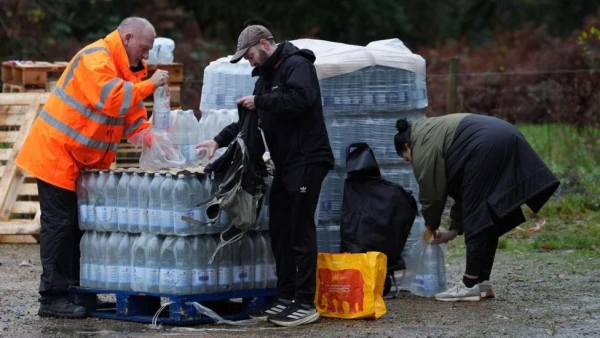
The chairman of South East Water has publicly acknowledged the company's failure to deliver basic services during severe winter outages that left tens of thousands of customers without water for days.
Appearing before the Environment, Food and Rural Affairs Committee on Tuesday, South East Water chairman Chris Train told MPs the company "could have done better" and "failed on the basic objective of delivering water to customers." The admission came as the water supplier faces mounting criticism over supply issues that affected up to 30,000 properties in Kent and Sussex during November and December, with additional disruptions occurring just weeks later.
"It is absolutely untenable for customers to be without water," Train told the parliamentary committee.
Businesses reported losing tens of thousands of pounds due to the supply failures, while residents described the January outage—which the company blamed on Storm Goretti and power cuts—as "Armageddon." Several schools were forced to close as customers couldn't shower, bathe, or flush toilets.
Despite the company launching a £600,000 compensation fund for affected businesses, committee chair Alistair Carmichael dismissed the amount as insufficient, saying it "does not touch the sides."
Chief executive David Hinton, who earns a base salary of £400,000 and received a £115,000 bonus last year, has faced multiple calls to resign over the handling of the crisis. Train confirmed the board continues to support Hinton, who has surrendered his bonus for this year.
Tunbridge Wells MP Mike Martin criticized the company's leadership, calling their committee appearance a "pathetic performance" and suggesting the board was "failing in their job" by backing Hinton.
Consumer impact surveys reveal lasting consequences from the outages. According to Dr. Mike Keil, CEO of the Consumer Council for Water, 54% of affected customers now store bottled water in case of future disruptions, while nearly a fifth drink only bottled water following a boil water notice issued last year.
"This type of interruption, of this duration, has lasting damage and lasting consequences," Keil warned.
Environment Secretary Emma Reynolds called the water supply disruptions "completely unacceptable," while committee member Josh Newbury described SEW's communications during the outages as "haphazard and inconsistent."
Hinton admitted the company "got it wrong" in its communication response and failed to identify problems early enough at a treatment works in November, leaving homes without drinking water for nearly two weeks.
"If we had spotted it earlier we would have resolved it," Hinton conceded.
MP Henry Tufnell criticized the company for "not doing the basics," referencing a report highlighting SEW's lack of routine maintenance. The company has pledged to invest £2.1 billion in infrastructure and resilience over the next five years.
Train pointed to climate change as a contributing factor, stating that "the speed and severity of climate change in the South East particularly has outstripped reasonable predictions."
Regulatory pressure continues to mount, with Ofwat proposing a £22 million fine in March over disruptions affecting 286,000 people between 2020 and 2023—the second-largest fine ever proposed by the regulator. Ofwat is also investigating whether the company has breached its license conditions.
Ofwat chief executive Chris Walters told the committee they were seeing SEW make "steps forward," but cautioned that "only time will tell if those are sufficient."
South East Water, owned by investment and pension funds led by Utilities Trust of Australia, reported £1.3 billion in debt and pre-tax losses of £19.8 million for the year ending March 2025. The company serves approximately 2.3 million people across Kent, Sussex, Surrey, Hampshire, and Berkshire.