Names marked with an asterisk have been changed to protect identities.*
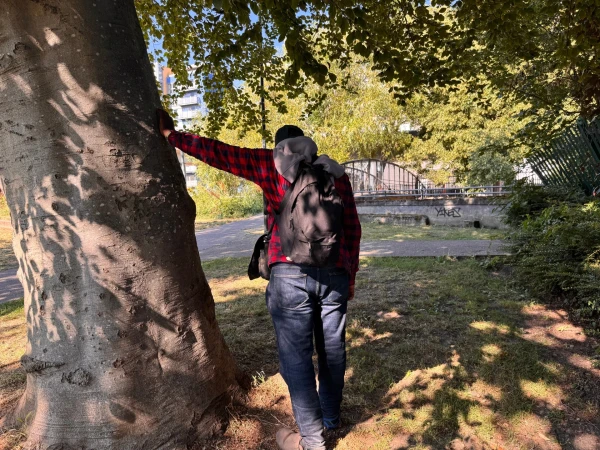
London, United Kingdom – Frank* spends his weekends with relatives in London. From Monday to Friday, he sleeps rough on the streets of southeast London, close to a church that once ran a support group he used to visit. It is not something he has told his employer, or the UK’s Home Office.
Recommended Stories
list of 4 items
- list 1 of 4Woman assaulted by Dutch police at asylum centre speaks to Al Jazeera
- list 2 of 4Life amid Canada’s ‘troubling’ shift on migrant rights
- list 3 of 4After a decade, Brexit’s cost to Britain is not only economic
- list 4 of 4‘I did nothing wrong’: Sweden’s migration regime hardens, upending lives
end of list Al Jazeera interviewed him as he was heading to work.
“I’m going for a night shift now carrying my belongings in this bag,” he said, adding that his colleagues can likely tell he is homeless. “But of course, they can’t confirm that I am on the street or not.”
The 38-year-old arrived in the UK from Nigeria in 2019 on a visit visa, then enrolled in a course, which would have seen him receive a student visa. But he could not afford the tuition fees. He is seeking asylum now for his safety, because of kidnappings in his hometown near Lagos.
He works part-time under a restricted arrangement while he waits for a decision. But he is still recovering from a fractured leg; he broke it in 2024 when jumping over a fence, fleeing an immigration check he feared was a ruse to detain him. He still walks with a limp.
“If I go back home, I would be classified as someone who is disabled, likely, because I won’t be at my normal capacity,” he said. “Disability almost means poverty back home, you’d end up begging on the streets.”
Back in Nigeria, he struggled to make ends meet as a schoolteacher. Now, he faces a new financial challenge.
Under the government’s new Immigration and Asylum Bill, people like Frank could be asked to repay a flat-rate contribution. It is expected to total around 10,000 British pounds ($13,360), towards the accommodation and subsistence support they received while their claims were processed.
The Home Office says the charge will apply to adults with access to sufficient funds, collected monthly above a set threshold, with full repayment required before a migrant becomes eligible for settlement. Home Secretary Shabana Mahmood said the move reflects that “receiving asylum support is a right, but it is also a responsibility”.
Get instant alerts and updates based on your interests. Be the first to know when big stories happen.
Frank said, “Even living here day to day is kind of expensive, you know, normally. If the payment is very flexible, it might not mean so much. But then if it is not flexible, it could be a form of captivity, I know that’s a very strong word. But it’s like you’re kind of tied to them, and not completely free.”
He worries the debt will simply push people back into hiding.
His own preference is a lower earnings threshold and repayment tied to people’s circumstances. “If you tell me I have to pay the government 10,000 pounds, I’ll be like – where do I get that from? But if you tell me to give back to the community by doing community service, mentoring someone, I’ll be happy to do that.”
Shams Moussa, who now has permanent residency, said the asylum-seeking process is torturous [Photo courtesy of Shams Moussa]
Former asylum seeker Shams Moussa, 48, compared the process of seeking refuge to waiting on a health diagnosis.
“It’s like going for a cancer screening, waiting to hear if the doctor is going to give you the good news or the bad news,” he said. “The good news is you can stay in the country. The bad news is, ‘We don’t believe you so you can’t stay’, and your world comes crashing down in front of you.”
Since the start of this year, he has had permanent residency and the right to live, work and study without restrictions or visa requirements.
The new policy will not affect him, but will hit people he supports through community work.
Moussa argued the repayment figure ignores the reality of asylum seekers’ finances, including the roughly 50 pounds-a-week allowance ($67) many live on before any right to work is granted.
“You have to buy everything – including food, and sanitary towels,” he said, warning the financial obligations could push some, particularly women, “towards illicit or exploitative work simply to get by”.
Concepta Cassar, head of policy and communications at Migrants’ Rights Network, called the move “a punitive, performative policy” that piles debt onto people “before they can even catch their breath”.
The measure fits a wider pattern of treating migrants as a fiscal liability rather than as people with rights, she said, adding that the government should focus on taxing extreme wealth. The impact on public finances would be marginal, while the human cost with more precarity for people who have “already survived enough of it”, is almost certain, she said.
Right-wing political parties and media outlets often exaggerate the cost of asylum seekers in the UK by spreading misleading claims, which in turn fuels societal divisions.
Amina Khanom, director of Reset Communities for Refugees, decried the government’s move. Instead of pressuring refugees and migrants with debts, she said policies that would get people contributing sooner include faster claims processing, better early infrastructure, and safe routes. She noted that refugees “already contribute through work, taxes and the vital roles many go on to play in our society”.
UK Home Office data shows that income remains modest well after status is granted. Median annual earnings among asylum refugees in employment reached 13,000 pounds ($17,400) after eight years, rising to 23,000 pounds ($30,700) for those working full-time but only 10,000 to 11,000 pounds ($13,360 to $14,700) for those in part-time or irregular work. It is significantly lower than the median UK salary of 35,000 pounds ($460,750).
Moussa called the repayment bid a “gimmick idea” by the government.
“Nobody wants to go and sit in a hotel doing nothing. If anything, you want your asylum claim to be processed as soon as possible, so you can get on with your life, try to rebuild it, and give back to your community,” he said. “Seeking sanctuary is a basic human right; the government should not charge people for it or profit off it.”
For Frank, the debate is inseparable from the reasons he left home and the assumptions he said the policy feeds into.
“Where I come from in Nigeria, my particular home state, there have been instances of kidnappings and insecurity recently. So if I go back there, it can be tough indeed,” he said as he gathered his belongings. “You shouldn’t assume that all asylum seekers come here to be violent, to be involved in crime or to get benefits.”