‘Why do I need to change?’: the brides saying no to costly pre-wedding glow-ups | Well actually | The Guardian
Skip to main contentSkip to navigation
Close dialogue 1/1 Next image Previous image Toggle caption
Support the Guardian
Fund independent journalism
Support from $3.45 a weekSupport from $3.45 a week
US
The Guardian - Back to home The Guardian
- [x]
Show more Hide expanded menu
-
- News
-
- Opinion
-
- Sport
-
- Culture
-
- Lifestyle
-
Search input google-search Search
-
* [Search jobs](https://jobs.theguardian.com/) -
Search input google-search Search
- [x]
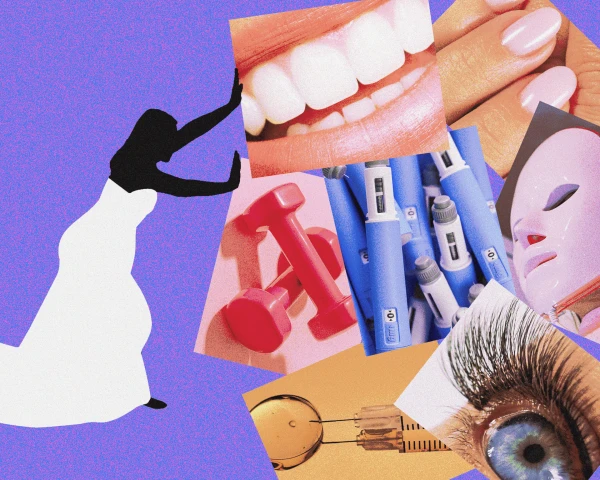
‘Conforming to 2026 bridal beauty standards is such an endless task that it might actually be easier to accept myself as I am.’ Illustration: Guardian Design / Getty Images
‘Conforming to 2026 bridal beauty standards is such an endless task that it might actually be easier to accept myself as I am.’ Illustration: Guardian Design / Getty Images
‘Why do I need to change?’: the brides saying no to costly pre-wedding glow-ups
In the age of Botox, Ozempic and injectables, some women want to spend less on bridal beauty – and just be themselves
Tue 12 May 2026 12.00 EDT Last modified on Tue 12 May 2026 16.41 EDT
Share
I got engaged last summer. Immediately, I started imagining how I would look at my wedding. The woman who appeared in my mind had different hair, different teeth and a completely different body than me. “I will transform my arms by the time of my wedding,” I kept thinking, though I did not take any action to transform my arms. It was inconceivable that I would show up to my wedding looking like myself.
Each social media app fed me wedding prep recommendations, including dieting (rebranded as “eating clean”), working out five times a week, regular laser treatments and facials, red light therapy, lymphatic drainage massage, teeth whitening, Russian manicures, eyelash extensions and multi-step hair routines. I saw an essay by a woman who wrote about spending $30,000 on her physical appearance. “In the lead-up to my wedding I treated my body like a design project and gave myself full [rein] to indulge in every and anything I had ever remotely considered,” she explained.
That number sounds extreme, but I can see how she got there. When I called my local med spa in San Francisco to get a quote for skin treatments I had heard about in bridal forums, the receptionist told me that a single session of BroadBand Light laser would be $550, plus $1,200 for microneedling. “Those are typically done in a series,” she said; the salon sold laser treatments in packs of three and five.
‘I wanted to look and feel expensive’: four couples on why they took on wedding debt Read more
Like many people – including, increasingly, men – I treat my appearance like a hobby, the way a car fanatic might daydream about ways to improve their Porsche. But when it comes to adding thousands of dollars of treatments on top of my already-extensive hair care and skincare routine for my wedding, I have to ask: who would all of this be for? Presumably, every attendee likes me, regardless of my skin luminosity or upper arm circumference. So what plus one or random social media follower am I trying to impress?
It would be nice to look dazzlingly beautiful at my wedding, but I just don’t know if I can be bothered to find a $699 infrared sauna blanket or cut out gluten. I think it might be more freeing to look … mid. Mid, and happy. It’s not that I’m deeply principled. It’s just that conforming to 2026 bridal beauty standards is such an endless task that it might actually be easier to accept myself as I am.
I sought out women who are also negotiating ways to show up at their wedding looking like themselves.
Jackie Wegner, 29, told me that as she prepared for her Cape Cod wedding last summer, well-wishers inquired about her new beauty routine. Did she plan, one friend asked, to go on a GLP-1 weight-loss drug?
Wegner, who has dealt with an eating disorder, was confused.
“My husband chose to marry me,” she reasoned. “Nobody was coming to my wedding because they wanted to see if I had lost weight or done something different with myself.” Ahead of her wedding, she maintained her regular beauty routine, and didn’t try to lose weight.
“Why would I need to change?” she said.
Natalie Craig, 34, has tried to curate a social and digital life that decenters thinness. But as soon as she got engaged, her feeds served up videos of women making comments like: “When I walk down the aisle I want to be so thin that you don’t even see me.” She shopped at bridal boutiques that serve plus-sized clients, which she thought would be more inclusive, but still ended up with an attendant who said, as she was naked: “This is going to suck you right up!”
The rise of weight-loss drugs, she said, has made this rhetoric harder to avoid.
“Thirty years from now, will [I] be looking at [my] wedding pictures and being like: ‘I should have lost five pounds?’” she wondered. “Maybe! But that’s so miserable. I just want to be exempt from that experience.”
Weddings have long been fraught with pressure on women to stretch, pilates-style, towards the apex of conventional beauty standards. The seeming omnipresence of weight-loss drugs, plastic surgery and injectables have only pushed that apex higher. Julia van der Hoeven, 32, told me she swiped through TikTok looking for planning inspiration before her December wedding at an estate outside Melbourne, Australia. Instead, she found “brides live-vlogging their injections into their faces”, she said. “You feel like you have to do it, too.”
That feeling is not unusual. A survey from the wedding planning site Zola found that nearly 80% of couples felt “pressure to change their appearance” ahead of their wedding day, and that couples spent an average of $1,100 on beauty and wellness preparations. “Advertisers have far more access to people these days,” says Helen Grace, a writer and critic of what she calls “the insecurity industry” – that is, the profit machine based on messaging that women’s bodies are flawed. That industry, she says, “is really able to – from the moment people wake up to the moment they go to sleep – make women feel worried or insecure about their wedding day”.
The endless “journey towards the imagined self” makes beauty not just a social standard but an “ethical ideal”, philosopher Heather Widdows argues in the 2018 book Perfect Me. Thus, “appearance becomes a proxy for, and intimation of, character and value”, she writes. A person with clear skin and shiny hair beneath her veil, for example, may telegraph to friends, family, followers and herself that she is more worthy of being chosen and celebrated.
skip past newsletter promotion
Sign up to Well Actually
Free weekly newsletter
Practical advice, expert insights and answers to your questions about how to live a good life
Enter your email address
Marketing preferences
- [x]
Get updates about our journalism and ways to support and enjoy our work.
Sign up**Privacy Notice:**Newsletters may contain information about charities, online ads, and content funded by outside parties. If you do not have an account, we will create a guest account for you on theguardian.com to send you this newsletter. You can complete full registration at any time. For more information about how we use your data see our Privacy Policy. after newsletter promotion
‘I don’t owe anyone anything on my wedding day’
Molly Scullion, 30, got married in 2024 in Lancaster, Pennsylvania, in a refurbished cigar factory. “My initial reaction, once we set our date, was: ‘OK, I have X amount of months to make it to this weight,’” she said. She decided to put the thought out of her mind. But soon, guilt crept in. “Am I not doing enough?” she wondered. “Should I be changing myself?”
Pre-wedding, Scullion took some time away from social media “to really think about what makes me feel as beautiful as I can be”. Her guilt abruptly disappeared. “I don’t owe anyone anything except for myself on my wedding day,” she decided. She got facials and a spray tan, but decided not to worry about her body shape and size.
On the day, she didn’t worry about how her body looked at all. “I ultimately was so happy that I had decided to let go of any expectations of what my body was going to look like on my day so that I could just be present.”
The pressure to “look the most beautiful you’ve ever looked” at your wedding, said Scullion, also arises partly from the expense of the day. Once you spend on a dress, on makeup and hair, on a photographer, “all of that pressure – ‘it has to pay off, it has to look perfect’ – I think it really weighs on people”, she said.
“You spend money on professional photography and videography that you’ll hopefully show your children and grandchildren and nephews and nieces and say: ‘Look how beautiful mum was on her wedding day,’” said Van der Hoeven. Ahead of her wedding, she went to a dermatologist to get Botox and filler. Her injector also advised her to get a chemical peel, claiming that this would allow for a smoother makeup application on the wedding day.
“It was a disaster,” said Van der Hoeven, laughing. “It made me break out three weeks before the wedding, so I was beside myself.”
She didn’t regret any of her treatments, except the chemical peel. “I don’t know if I looked as good as I was expecting,” she said. “Maybe I built up my expectations a little bit too high as a result of getting so much done to my face.”
It isn’t reasonable, Widdows argues in her book, to expect people to shrug off the beauty standard. “Simply telling individuals to reject it is unfair and unrealistic” for a number of reasons, she writes. Failing to uphold beauty standards comes with a cost, both from external forces (say, a wedding guest calls you “brave” for showing your arms) and internally (you risk spending your wedding day worrying about your arms).
“I think anyone should be able to do anything they want with their body, but I just wish we were all so much nicer to ourselves and less critical of ourselves on a day that’s meant to be about celebrating the love you found,” said Craig, who is getting married this September. “I think we diminish it all by trying to turn ourselves into something different.”
Wegner, who was married at an inn off the cliffs of Nantucket, landed in the same place after dodging those early questions about GLP-1s and TikToks about arm liposuction.
“I look back on pictures and I’m smiling and I look like me,” she said. “I felt so beautiful. I felt like myself.”
Our annual appeal to defend press freedom
0 of 60,000 acts of support
At this dangerous time
We hope you appreciated this article. Before you close this tab, we want to ask if you could support our annual press freedom appeal at this dangerous time for journalism in the US.
According to a leading global watchdog, American democracy is now more imperiled than at any point since the 1960s, marked by a precipitous decline in press freedom – driven by mounting pressure from the Trump administration in the form of threats, criminal investigations, politicized regulation, frivolous lawsuits and, for public media, catastrophic funding cuts.
Meanwhile, organizations that are supposed to be independent like the FBI and the FCC, our radio and television regulator, have also been targeting press freedom under Trump-aligned leadership, with the FBI raiding a reporter’s home and the FCC threatening ABC’s TV licenses after Jimmy Kimmel made a joke about Melania Trump.
The response from some ultra-wealthy and corporate media owners, keen to appease the president, has been chilling: CBS News has been taken over by a Trump ally; CNN is poised to be taken over by the same billionaire; Jeff Bezos has continued to impose cuts and editorial interventions at the Washington Post; and multiple outlets have settled multimillion-dollar lawsuits from the administration to protect their business interests.
Democracy is best served by a robust, thriving free press. But when that freedom is under attack, it falls to a determined few news organizations to ensure the full truth still reaches the public. Owned neither by a billionaire nor a corporation, the Guardian remains dedicated to covering this administration with uncompromising moral and factual clarity – and to keeping trustworthy journalism paywall-free for the world.
Despite the risks of maintaining our fierce independence, what sustains us – and fills us with deep gratitude – is the unwavering support we’ve seen from readers. It is no exaggeration to say that we are here because of you: a majority of our funding comes directly from people like you responding to messages like this. Your support not only powers our work, but more importantly, it safeguards the financial independence that underpins our editorial freedom and courage.
In honor of World Press Freedom Day this month, we’re looking for 60,000 readers to support our annual appeal with $5 or more. Do you have the means to be one of them? We’re especially grateful for anyone able to set up a monthly contribution: reliable funding is vital for sustaining us throughout this dangerous period, right to its end.
We would be hugely grateful for your backing to mark this global day of solidarity for independent journalism. Anything you can spare goes directly toward our work – not into the pockets of a billionaire or corporation with other interests at heart. It takes less than a minute. Thank you for protecting the truly free press.
Support $5/monthly
Recommended
Support $15/monthly
Unlock All-access digital benefits:
- Far fewer asks for support
- Ad-free reading on all your devices
- Unlimited access to the premium Guardian app
- Regular dispatches from the newsroom to see the impact of your support
- Unlimited access to Feast, the Guardian recipe app
Support once from just $1
Remind me in June
Explore more on these topics
Share
Most viewed
- #### Trump lands in China for high-stakes summit with Xi Jinping, as Iran war looms over talks
- #### ‘Irresponsible’: backlash as Utah approves datacenter twice the size of Manhattan
- #### Smuggled in syringes: how Nairobi became a nexus for the black market in giant harvester ants
- #### Single women are buying more houses. The men they are dating are not responding well
- #### ‘I’m afraid if she gets out’: US author’s sons say they want mother to stay in jail
Related stories
Related stories
- ### How do I respond to my friends when they criticize their own weight and looks? 28 Apr 2026
- ### ‘It’s my F-you ring’: why divorced women are transforming their wedding jewelry 4 Mar 2026
- ### ‘I chose red’: why these brides ditched the white wedding dress for colorful gowns 23 Sept 2025
- ### I don’t wear makeup but my wedding is coming up – can I go bare-faced? 19 Mar 2025
- ### Post-wedding anxiety is ‘really common’. Here’s how to cope 11 Jul 2024
- ### Missing rings and an uninvited dog: four readers share their wedding disasters 31 May 202497 97 comments
- ### Something old: why six brides picked a second-hand wedding dress 5 May 2024
- ### There was no time for a wedding – so we eloped. Maybe you should too 3 May 2024
More from Lifestyle
More from Lifestyle
- ### When I want to feel loved, I just go to a hardware store 19m ago
- ### Australian fashion week welcomes a new wave of maturity landing on the industry’s runways 1h ago
- ### Cozy Earth review: I tested the buzzy bedding and sleepwear brand. Here are its best, most comfy pieces 2h ago
- ### Jess Cartner-Morley on fashion: forget the church fete vibes, the brooch is now fashion’s badge of honour 3h ago32 32 comments
- ### Single women are buying more houses. The men they are dating are not responding well 5h ago
- ### The lollipop people crisis: what does the road rage against them say about Britain today? 7h ago
- ### From mountain photography to ice-climbing – try it all at this summer festival in the French Alps 10h ago
- ### A moment that changed me: I saw my first total solar eclipse – and its beauty shook me to my core 10h ago68 68 comments
- ### Getting children to eat their vegetables starts in the womb, researchers suggest 12h ago
Most viewed
Most viewed
Most viewed Across the Guardian
-
Trump lands in China for high-stakes summit with Xi Jinping, as Iran war looms over talks
-
‘Irresponsible’: backlash as Utah approves datacenter twice the size of Manhattan
-
Smuggled in syringes: how Nairobi became a nexus for the black market in giant harvester ants
-
Single women are buying more houses. The men they are dating are not responding well
-
‘I’m afraid if she gets out’: US author’s sons say they want mother to stay in jail
-
France confines more than 1,700 people to cruise ship after suspected norovirus outbreak
-
Nebraska Democratic Senate primary winner says she’ll drop out to support independent in general election
-
Alex Murdaugh’s murder convictions overturned by South Carolina supreme court
-
Russian ship that sank near Spain may have been carrying nuclear reactors to North Korea
-
Second indictment of ex-FBI chief James Comey signals retaliation fears
Most viewed in Wellness
-
Very difficult and extremely cool: how to start doing pull-ups
-
‘Why do I need to change?’: the brides saying no to costly pre-wedding glow-ups
-
I didn’t think I could get addicted to weed. I was wrong – and I’m not alone
-
‘Do you think I’m a cougar?’: five influencer couples on their age-gap relationships
-
‘I felt like I’d stumbled on a cheat code’: what is the burned haystack dating method?
-
What is a deep plane facelift? Nipping into the buzzy cosmetic procedure
-
What do we mean when we say women can be ‘too muscular’?
-
A mastectomy broke my body. CrossFit reminded me I was still alive
-
From ‘it helped me stick to a routine’ to ‘I despise it’: 11 people explain how they’re using AI for fitness
-
‘People are turning themselves into lab rats’: the injectable peptides craze sweeping the US
Original reporting and incisive analysis, direct from the Guardian every morning
-
California resident – Do Not Sell or Share
Support the Guardian
Available for everyone, funded by readers
© 2026 Guardian News & Media Limited or its affiliated companies. All rights reserved.(dcr)