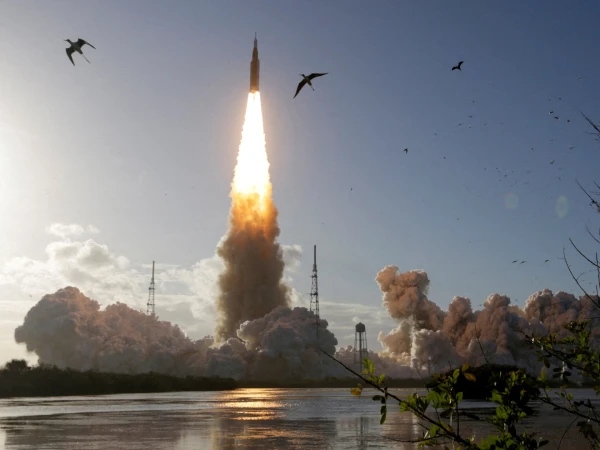
The four astronauts of NASA's Artemis II mission are now in the final stages of their journey home, preparing for a dramatic splashdown in the Pacific Ocean after completing humanity's first crewed lunar flyby in over five decades.
Having successfully orbited the Moon and conducted critical systems checks on the Orion spacecraft, the crew is now focused on the delicate and dangerous re-entry procedure. The capsule must withstand temperatures nearing 5,000 degrees Fahrenheit as it slices through Earth's atmosphere at approximately 25,000 miles per hour.
"This is the moment where our training meets reality," said mission commander Christina Koch in a final transmission before the blackout period. "We are confident in our spacecraft and our team on the ground. Our focus is on executing a safe return for ourselves and for the data we're bringing home."
The recovery operation, led by the USS Portland, is already positioned in the primary landing zone off the coast of California. Navy divers and NASA personnel will secure the capsule and assist the astronauts immediately after splashdown. Medical teams are standing by to conduct initial health assessments, given the crew's prolonged exposure to deep-space radiation and microgravity.
This successful return would mark a pivotal milestone for NASA's Artemis program, proving the Orion spacecraft's capability to safely transport humans to the Moon and back. The mission's data is expected to inform the planning for Artemis III, which aims to land astronauts on the lunar surface later this decade.
NASA Administrator Bill Nelson stated: "Artemis II is the final proving ground before we return boots to the Moon. Their safe return is our absolute priority and will herald a new chapter of sustained lunar exploration."
Following extraction from the capsule, the astronauts will be transported to a nearby medical facility for detailed evaluation and a period of readjustment to Earth's gravity. A full mission debrief and public celebration are planned for the coming weeks.