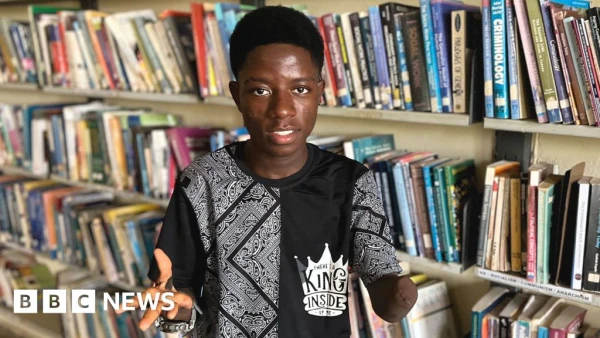
At just 13 years old, Ovey Friday faced a nightmare that would change his life forever. Accused of witchcraft by his stepmother, he was taken to a traditional shrine in Nigeria's Nasarawa state where he endured brutal torture. When police finally intervened, the damage was irreversible—doctors had to amputate his left hand and several fingers on his right hand.
"I cried and I cried," recalls Friday, now 19, describing the moment he woke from surgery. "The herbalist brought charcoal, put something on my hands, tied my hands with my leg, put pepper there inside the charcoal, then covered me with a bedsheet."
Despite the trauma and the stares he received on the streets, Friday remained determined to pursue his education. But his academic ambitions nearly ended two years ago when he attempted to take Nigeria's university entrance examination. The biometric fingerprint system couldn't accommodate his scarred hands, threatening to exclude him from higher education entirely.
Thankfully, disability rights advocates intervened, convincing officials to accept his toe print as identification verification. Today, Friday is studying English and literary studies at a Nasarawa university, becoming the first in his family to attend higher education.
"Not everyone has someone to push for them," Friday notes. "Some people will just stop trying."
Friday's story is just one example of the challenges facing Nigeria's estimated 35 million people with disabilities—roughly 15% of the population. Scarlett Eduoku, a radio presenter in Kano state, faces similar obstacles with facial recognition technology due to a missing left eye she lost as a toddler.
"Many apps do not facially recognize me," Eduoku explains. This limitation forced her to travel to her phone provider's headquarters just to upgrade her SIM card from 3G to 5G—a process most Nigerians can complete remotely.
While Nigeria passed landmark legislation in 2019 prohibiting discrimination against disabled people and guaranteeing access to public services, implementation has been slow. Ayuba Burki-Gufwan, executive secretary of the National Commission for Persons with Disabilities, describes progress as "more or less at snail's speed."
Still, there are signs of change. The Joint Admissions and Matriculation Board has dropped examination fees for people with disabilities and created dedicated testing centers. The Federal University of Lafia has waived up to 75% of fees for disabled students, resulting in what Burki-Gufwan calls "a huge upsurge" in enrollment.
"The journey of a thousand miles begins with a step," Burki-Gufwan says, expressing cautious optimism.
Yet significant barriers remain. Chukwuemeka Chimdiebere, a Lagos-based special educator, emphasizes that true inclusion requires more than just physical accommodations.
"Inclusion is not a favour. It is a responsibility," Chimdiebere states. "Many persons with disabilities are not limited by their impairment. They are limited by systems that were never designed with them in mind."
For Abiose Falade, a 48-year-old author in Ibadan who uses a wheelchair, the challenges are both physical and social.
"There's a list of places I can go and a list I can't," Falade explains. "When I want to go out, I take someone with me so that when people start staring, start pointing, I don't notice. It's easier than facing it alone."
Physical infrastructure presents additional hurdles. Uneven pavements, wide drainage gaps, and scarce dropped kerbs make Nigerian cities difficult to navigate for wheelchair users. Public buildings rarely have ramps, and Nigeria must import every wheelchair, hearing aid, and mobility device—creating accessibility and affordability challenges.
Advocates are calling for 1% of government budgets at all levels to be reserved for disability inclusion. They argue that while funding is important, stronger commitment and enforcement of existing laws are equally critical.
As Opeyemi Ademola, a 28-year-old project manager with mixed hearing loss, demonstrates through his successful career, disability doesn't define capability—but inclusive systems do. His experience in meetings and noisy environments requires adaptations that many workplaces still don't provide.
For students like Ovey Friday, each small victory represents a step toward a more inclusive Nigeria—one where determination, rather than disability, shapes educational outcomes.