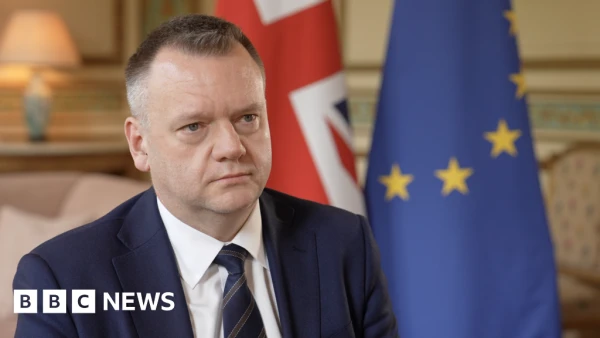
In an era marked by unprecedented global instability, the United Kingdom is pursuing a calculated strategy to strengthen its relationship with European neighbors, balancing economic necessity against political constraints.
UK Minister for EU Relations Nick Thomas-Symonds has characterized the approach as "ruthlessly pragmatic," telling reporters in Brussels that geopolitical turbulence has created new imperatives for cooperation. "We find ourselves in a dangerous situation in the world," he explained, noting that public sentiment appears increasingly receptive to closer UK-EU relations amid ongoing conflicts and economic pressures.
"I do find a support for closer UK–EU relations… I think there is a particular imperative at the moment," Thomas-Symonds stated during discussions at the UK ambassador's residence in Brussels.
Security collaboration has already intensified, with Britain assuming leadership roles in coordinated responses to the Ukraine conflict and participating in joint European defense procurement initiatives. However, the government's focus is expanding to encompass economic ties nearly a decade after the Brexit referendum.
Prime Minister Keir Starmer's administration has committed to reducing post-Brexit barriers for British businesses trading with their largest export market. By this summer's anticipated EU-UK summit, officials aim to finalize agreements covering food safety standards, carbon emissions trading, and a youth mobility program facilitating temporary work and study exchanges.
This week marked another milestone as Britain rejoined the Erasmus+ educational exchange scheme, though the program carries a substantial £570 million price tag for its inaugural year. Similarly, participation in the Horizon research initiative costs taxpayers £2.2 billion annually, though proponents note Britain has become a leading beneficiary of the flagship science program.
The government maintains these selective alignments respect Brexit's fundamental principles, avoiding re-entry into the single market or customs union while leveraging sovereignty to secure sector-specific advantages. Starmer is reportedly preparing legislation that would streamline regulatory harmonization with European standards for certain goods and services.
Opposition voices from across the political spectrum have raised concerns. Reform UK and Conservative critics argue alignment transforms Britain into a "rule taker" rather than rule maker, contradicting Brexit's promise to "take back control." Nigel Farage has denounced proposed legislation as "a backdoor attempt to drag Britain back under EU control," while Business Secretary Kemi Badenoch challenged ministers to openly advocate EU membership if that represents their true objective.
Conversely, Liberal Democrats and Greens contend the government isn't pursuing integration aggressively enough to stimulate economic growth, leaving Labour seemingly trapped between practical needs and ideological boundaries.
European officials emphasize that closer cooperation inevitably carries conditions. French MEP Natalie Loiseau, a key ally of President Emmanuel Macron, noted that EU requirements remain unchanged since Britain's departure: deeper market access necessitates greater regulatory alignment. Brussels could eventually demand concessions on freedom of movement—a current government red line—if Britain seeks extensive single market integration.
Ongoing electricity market negotiations illustrate the complex trade-offs. While Thomas-Symonds identifies energy security as paramount following price surges triggered by the Ukraine war and Middle Eastern tensions, EU negotiators insist Britain must contribute to the cohesion fund supporting poorer regions as part of any agreement.
When questioned about potential financial contributions, Thomas-Symonds dismissed the demand as merely "the EU's opening position," suggesting Britain will resist terms deemed unfavorable. He has similarly declined participation in the EU's SAFE defense loans scheme due to prohibitive €2 billion membership costs and emphasized Britain's independent approach to artificial intelligence regulation.
The minister remains guarded about future alignment sectors, though the government insists any agreements will strictly serve national interests. As geopolitical volatility reshapes international relationships, Britain's evolving European strategy continues navigating the delicate balance between cooperation and sovereignty.