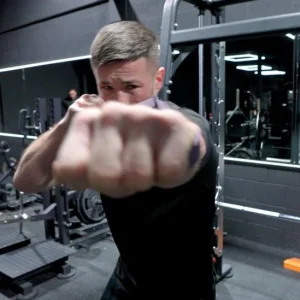
Liam Rees knows that stepping into the ring without gloves is a gamble. A carpenter by day, the 31-year-old Welshman moonlights as a competitor in a combat sport so visibly vicious that it has spent decades banished to the fringes of the fighting world.
Moments after surrendering his light-middleweight world title at Cardiff's Vale Sport Arena, a battered and bloodied Rees sat slumped in a chair. Beside him, his wife Emma gently pleaded with him to walk away from the violence, whispering, "No more now babe."
But the Swansea native is addicted to the thrill.
"You've got so much adrenaline pumping through your body in that ring. Some people think I'm crazy," Rees admits, noting that a single punch could alter his life forever, but his love for the sport keeps him coming back.
In sanctioned bare-knuckle bouts, competitors clash on a canvas half the size of a standard professional boxing ring. The confined space eliminates any chance to hide, guaranteeing a higher frequency of cuts, bruises, and dramatic knockouts—the exact visceral spectacle that draws its growing fanbase.
For Rees, the journey to the ring was a path to redemption. After battling substance abuse, a trainer introduced him to bare-knuckle fighting. Making his debut in 2023, he rapidly ascended to become a two-time world champion under the Bare Knuckle Boxing (BKB) promotional banner. During fight camps, he pushes his body through brutal three-a-day training sessions, five days a week, often sacrificing precious time with his two children.
Despite his championship pedigree, the prize money isn't enough to hang up his carpentry tools. Still, his ultimate motivation extends beyond financial gain. He aims to leave a lasting legacy and prove his worth to his home city.
While bare-knuckle fighting is the purest and oldest iteration of boxing, it was driven underground into illicit wasteland brawls following the introduction of the 1867 Marquess of Queensberry rules, which mandated the use of padded gloves.
Today, however, the gloves are permanently off, and the sport is experiencing a meteoric resurgence. According to BoxRec data, the globe hosted a mere 21 licensed bare-knuckle fights in 2015. Last year, that number exploded to over 1,000 across 21 different nations.
Rees fights for BKB, one of the leading global promotions alongside the American powerhouse Bare Knuckle Fighting Championship (BKFC). David Tetreault, president of BKB, notes that their events—capped at 2,000 attendees—routinely sell out. The bloody spectacles are now broadcast in over 60 countries, bolstered by strategic partnerships with major networks like VICE TV and TalkSport.
The sport's rising legitimacy is further cemented by the influx of former gloved world champions, including Lee Selby, Paulie Malignaggi, and James DeGale, who have all crossed over to test their mettle with bare fists.
Yet, as the sport fights for mainstream acceptance, medical professionals and advocates are raising serious alarms. Luke Griggs, the chief executive of the brain injury charity Headway, expressed profound concern regarding the sport's rapid growth. He warned against the "glamourisation of a sport that's going to be taken out into the streets," highlighting the severe neurological risks fighters face every time they toe the line.