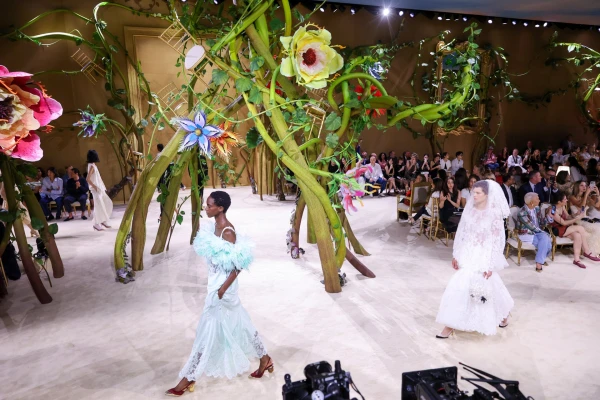
The first model on the Chanel catwalk was wearing a sheer mousseline skirt suit and carrying a tiny century-old leatherbound book of fairytales that once belonged to Coco Chanel herself. With the Lord of the Rings soundtrack booming through a stage set of giant parasol-scale poppies and lupins as tall as giraffes, the clothes narrated the stories in the pages. A row of buttons on the spine of a dress began with an ugly duckling, and ended with a swan. A Goldilocks minaudière handbag was fashioned in the shape of a golden sleeping bear. The lining of a jacket was hand-painted with a scene from Puss in Boots.
A sheer skirt suit with embroidery. Photograph: WWD/Getty Images
But Matthieu Blazy, holding the same book in his hands backstage after the show, told reporters that his favourite fairytale was the rags-to-riches story of Coco herself. “She climbed the ladder to find her golden goose, by making clothes for real women. Her clothes were never parodies. They were rooted in life,” Chanel’s creative director said.
An opening look from the show. Photograph: Marc Piasecki/Getty Images
A cast of women of all ages included Stephanie, a model who was celebrating her 50th birthday walking the Chanel catwalk in a red sequined dress, surely a fairytale way to mark that occasion. “That was a super-beautiful moment for us backstage,” said Blazy. “ I love the way the older women move in the clothes, and I love the mentorship and conversation they have with the younger kids.” The wedding dress that features in every couture show – bridal gowns making up a hefty chunk of orders – was demoted from finale position, so that the show closed with a sinewy little black dress that Blazy called a “revenge” dress. “It seemed like the right way to end the story, because Gabrielle [Coco] never got married.” The simple black dress channelled her spirit.
Stephanie marks her 50th birthday with a red sequined dress. Photograph: Stéphane Cardinale/Corbis/Getty Images
“We love doing red carpet, dressing Teyana Taylor or Nicole Kidman, but for me fashion is about the adventure of the everyday. Fashion is not about the big ‘wow’ dress, it is clothes that you fold and put in your suitcase,” he said. To celebrate the adventure of the everyday, the lining of a jacket was decorated with to-do reminders and supermarket shopping lists hand-embroidered by the Parisian house of Lesage on to squares of yellow silk, to look like Post-it notes.
skip past newsletter promotion after newsletter promotion
The ‘revenge’ dress. Photograph: Marc Piasecki/Getty Images
Beyond the whimsy, there was a clear fashion story here for the world beyond the tiny couture clientele. Sheer layers are an emerging trend, with worn-to-be-glimpsed sturdy knickers and bra tops worn under semi-transparent clothes. The silhouette is emphatically untucked, with the new version of a skirt suit a fluid skirt beneath a billowing blouse. Nostalgic pastel shades of lilac and mint are a breath of fresh air after seasons of minimal neutrals. In many of these directions, Chanel echoed the looks seen on Monday on Dior’s haute couture catwalk.
Bruno Pavlovsky, Chanel’s president of fashion, described it as “the best show ever” in haute couture. “The storytelling behind this collection is stunning,” he said. There is fairy dust around Chanel since Blazy’s appointment, with boutiques packed. The appetite for a new era of Chanel is being seen in strong demand for the new, slouchier “25” bag, which is becoming as desirable to clients as the classic flap-closure shape.
Pavlovsky’s biggest challenge right now is finding and training the growing workforce in the Chanel ateliers. Despite the recent acquisition of the renowned Parisian shirtmakers Charvet, Pavlovsky insists Chanel has no plans to diversify into menswear. “We are not dressing men. We are not in hospitality; we are not opening Chanel restaurants. We are not trying to compete with Vuitton. We are not listed; we don’t have the pressure to do everything. Everything we do is about fashion for women.”
At this dangerous time
We hope you appreciated this article. Before you close this tab, we want to ask if you could support the Guardian at this dangerous time for journalism in the US.
According to a leading global watchdog, American democracy is now more imperiled than at any point since the 1960s, marked by a precipitous decline in press freedom – driven by mounting pressure from the Trump administration in the form of threats, criminal investigations, politicized regulation, frivolous lawsuits and, for public media, catastrophic funding cuts.
Meanwhile, organizations that are supposed to be independent like the FBI and the FCC, our radio and television regulator, have also been targeting press freedom under Trump-aligned leadership, with the FBI raiding a reporter’s home and the FCC threatening ABC’s TV licenses after Jimmy Kimmel made a joke about Melania Trump.
The response from some ultra-wealthy and corporate media owners, keen to appease the president, has been chilling: CBS News has been taken over by a Trump ally; CNN is poised to be taken over by the same billionaire; Jeff Bezos has continued to impose cuts and editorial interventions at the Washington Post; and multiple outlets have settled multimillion-dollar lawsuits from the administration to protect their business interests.
Democracy is best served by a robust, thriving free press. But when that freedom is under attack, it falls to a determined few news organizations to ensure the full truth still reaches the public. Owned neither by a billionaire nor a corporation, the Guardian remains dedicated to covering this administration with uncompromising moral and factual clarity – and to keeping trustworthy journalism paywall-free for the world.
Despite the risks of maintaining our fierce independence, what sustains us – and fills us with deep gratitude – is the unwavering support we’ve seen from readers. It is no exaggeration to say that we are here because of you: a majority of our funding comes directly from people like you responding to messages like this. Your support not only powers our work, but more importantly, it safeguards the financial independence that underpins our editorial freedom and courage.
We know our requests for support are not as welcome as our reporting, but without them, it’s simple: our reporting wouldn’t exist. Of course, we understand that some readers are not in a position to support us, and if that is you, we value your readership no less.
But if you are able, please support us today. All gifts are gratefully received, but a recurring contribution is most impactful, helping sustain our work throughout the year ahead (and among the great benefits, we’ll show you far fewer fundraising requests like this). It takes just 37 seconds to give. Thank you for protecting the free press.
Support $1.15/week
Recommended
Support $3.45/week
UnlockAll-access digitalbenefits:
- Far fewer asks for support
- Ad-free reading on all your devices
- Unlimited access to the premium Guardian app
- Regular dispatches from the newsroom to see the impact of your support
- Unlimited access to Feast, the Guardian recipe app
Support once from just $1