The one person in the fashion industry who doesn’t want to talk about Taylor Swift’s as-yet-unrevealed wedding dress is the man who actually knows what it looks like. “It was a big honour,” was all that Dior’s Jonathan Anderson would say about dressing America’s de facto royal wedding. “But no, I can’t tell you anything about it. It will all come out in due course. It was a joy to work with her and we became very good friends. It is an emotional thing, doing someone’s wedding.”
Jonathan Anderson is re-energising Dior with an offbeat creative energy. Photograph: Kenzo Tribouillard/AFP/Getty Images
Instead, Anderson wanted to talk about a very different American artist, sculptor Lynda Benglis, whose sensual slumped hunks of smelted metal inspired his haute couture collection. A wooden pavilion built for the show in the gardens of the Rodin Museum was soundtracked with the flutter of paper fans along the front row, and the haughty silhouettes of couture seemed liquefied in the city heat. A skirt of silver-foiled petals lapped and shimmered like molten lava. A tailored Bar jacket trailed threads of chiffon at the hem like drips of ice-cream down a cone.
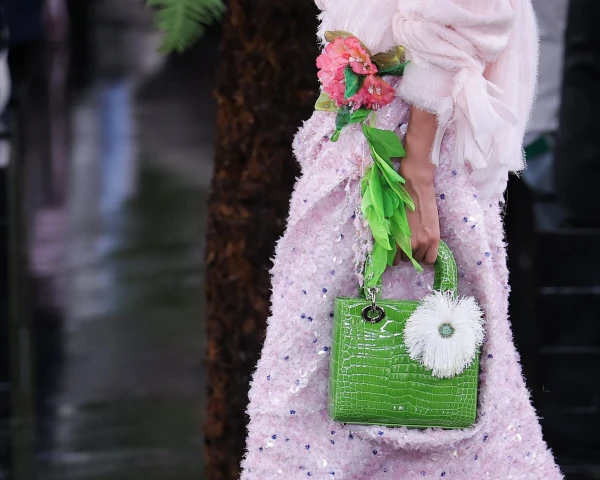
This is how haute couture operates. The most exclusive branch of fashion is a high-rolling play for mass-culture eyeballs and a painstaking laboratory for artistic expression in which evening bags are crafted from fragments of 18th-century Indian chintz fabric in a commentary on the enmeshment of decorative traditions across cultures.
Hot on the heels of the coup of dressing Swift, this was a high-concept collection which riffed on how clothing turns fabric into sculpture and included an IYKYK reference to Benglis’ 1974 self-portrait Centrefold, in which she is naked and holding a giant dildo. (Because couture is also a shop window for the wardrobes of billionaires, the Centrefold image was blurred out, to avoid offending potential clients.)
There was pure glamour on show. Photograph: Kenzo Tribouillard/AFP/Getty Images
“I think she’s a genius. She was well before her time – before anyone’s time,” Anderson said of Benglis at a preview. He is upholding his predecessor Maria Grazia Chiuri’s tradition of putting female artists at the centre of the Dior world. His debut couture collection, shown in January, was a celebration of the work of ceramicist Magdalene Odundo.
Anderson’s Dior is razzmatazz but with a sideways bent. His strategy of re-energising the grand house with offbeat creative energy is high-risk, but it is working. In the front row Sabrina Carpenter, in a coquettish ivory lace cocktail dress, sat alongside Josh O’Connor in a deconstructed sheer blazer and sequined cravat.
skip past newsletter promotion after newsletter promotion
The first look on the catwalk was a floppy satin shirt with black plisse trousers, shrouded in an oversized shearling shawl and topped with an acorn-shaped bonnet: more downtown gallery opening than uptown lunch date. But there was pure glamour, too, in a silver lamé bustier dress knotted with an outsize bow, a delicious cowl-backed peach silk slither of an evening gown, and a sculpted hourglass jacket in silk jacquard embossed with silk ferns.
The finale was a wedding dress, as is traditional at haute couture. The strapless pearl column, veiled in a canopy of hand-pleated chiffon embellished with white feather dandelions and embroidered cactus flowers, was spectacular. But it was not the Dior wedding dress everyone wanted to see.
At this dangerous time
We hope you appreciated this article. Before you close this tab, we want to ask if you could support the Guardian at this dangerous time for journalism in the US.
According to a leading global watchdog, American democracy is now more imperiled than at any point since the 1960s, marked by a precipitous decline in press freedom – driven by mounting pressure from the Trump administration in the form of threats, criminal investigations, politicized regulation, frivolous lawsuits and, for public media, catastrophic funding cuts.
Meanwhile, organizations that are supposed to be independent like the FBI and the FCC, our radio and television regulator, have also been targeting press freedom under Trump-aligned leadership, with the FBI raiding a reporter’s home and the FCC threatening ABC’s TV licenses after Jimmy Kimmel made a joke about Melania Trump.
The response from some ultra-wealthy and corporate media owners, keen to appease the president, has been chilling: CBS News has been taken over by a Trump ally; CNN is poised to be taken over by the same billionaire; Jeff Bezos has continued to impose cuts and editorial interventions at the Washington Post; and multiple outlets have settled multimillion-dollar lawsuits from the administration to protect their business interests.
Democracy is best served by a robust, thriving free press. But when that freedom is under attack, it falls to a determined few news organizations to ensure the full truth still reaches the public. Owned neither by a billionaire nor a corporation, the Guardian remains dedicated to covering this administration with uncompromising moral and factual clarity – and to keeping trustworthy journalism paywall-free for the world.
Despite the risks of maintaining our fierce independence, what sustains us – and fills us with deep gratitude – is the unwavering support we’ve seen from readers. It is no exaggeration to say that we are here because of you: a majority of our funding comes directly from people like you responding to messages like this. Your support not only powers our work, but more importantly, it safeguards the financial independence that underpins our editorial freedom and courage.
We know our requests for support are not as welcome as our reporting, but without them, it’s simple: our reporting wouldn’t exist. Of course, we understand that some readers are not in a position to support us, and if that is you, we value your readership no less.
But if you are able, please support us today. All gifts are gratefully received, but a recurring contribution is most impactful, helping sustain our work throughout the year ahead (and among the great benefits, we’ll show you far fewer fundraising requests like this). It takes just 37 seconds to give. Thank you for protecting the free press.
Support $1.15/week
Back independent journalism on a monthly basis.
Recommended
Support $3.45/week
UnlockAll-access digitalbenefits:
- Far fewer asks for support
- Ad-free reading on all your devices
- Unlimited access to the premium Guardian app
- Regular dispatches from the newsroom to see the impact of your support
- Unlimited access to Feast, the Guardian recipe app
Support once from just $1
We welcome support of any size, any time - whether you choose to give $1 or more