In the annals of military aviation, few aircraft embody the turbulent transition from piston-powered bombers to the jet age as dramatically as the Convair B-36 Peacemaker. Designed in the crucible of World War II to strike deep into Nazi-occupied Europe from American soil, the colossal bomber arrived just as the strategic landscape shifted beneath it—ushering in an era of nuclear deterrence and high-speed, all-jet warfare.
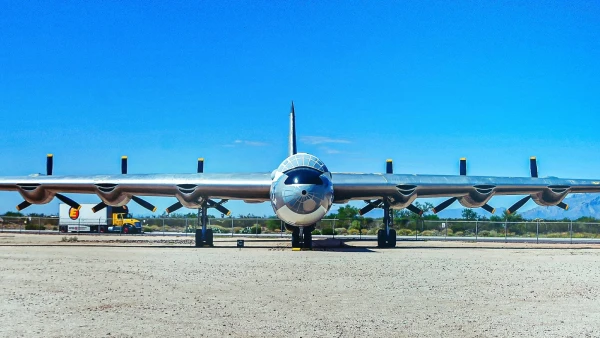
When the B-36 first took to the skies in August 1946, it was a marvel of engineering: a six-engine behemoth with a wingspan longer than a football field, capable of carrying up to 86,000 pounds of bombs across intercontinental distances. Its original mission—to bomb Germany from bases in the United States—had become obsolete by the time it entered service in 1948. Yet the bomber found new purpose as the first aircraft specifically designed to deliver the United States’ burgeoning nuclear arsenal, including the massive early hydrogen bombs that weighed as much as a small truck.
The Peacemaker’s design was a patchwork of innovation and compromise. Its primary power came from six Pratt & Whitney R-4360 Wasp Major radial engines, each with 28 cylinders and a thirst for fuel that bordered on absurd. To compensate for the bomber’s sluggish climb and takeoff performance, engineers bolted four General Electric J47 turbojets onto its wings—a stopgap measure that earned the aircraft the slogan "six turning and four burning." These jets were not meant for cruising; they were emergency boosters, firing up only for heavy-weight takeoffs, steep climbs, or high-speed dashes through enemy airspace.
"Powered by six Pratt & Whitney R-4360 engines, the B-36J cruised at 230 mph, but for additional bursts of speed its four General Electric J47s increased the maximum speed to 435 mph. Ultimately, the improvements addressed symptoms, but were unable to fix the underlying problem: the B-36 just didn’t belong in the jet age."
The bomber’s operational life was plagued by mechanical woes. The complex radial engines, prone to overheating and fires, required crews to replace a staggering 336 spark plugs per service—a logistical nightmare for maintenance teams. Its sheer size demanded vast resources to operate and keep airworthy, a burden that grew heavier as the Air Force pivoted toward sleeker, faster jet bombers like the Boeing B-52 Stratofortress.
By the time the B-36 was retired in 1959, it had never fired a shot in anger. It missed the Korean War entirely and was already obsolete by the time the Vietnam War began, where the B-52s dominated the skies. Today, only four complete B-36s remain, preserved in museums as relics of a bygone era—a time when the U.S. military still believed in the supremacy of piston-powered giants, even as the jet revolution reshaped warfare forever.