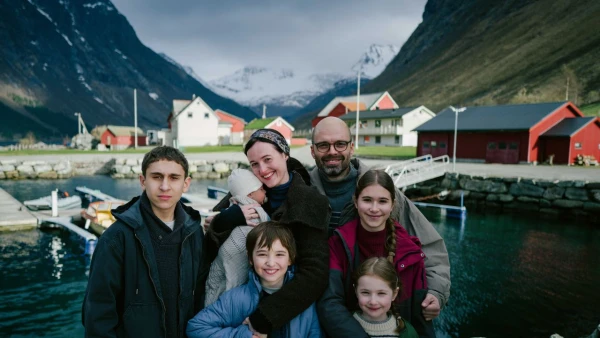
Cristian Mungiu, the acclaimed Romanian director behind Anatomy of a Fall, has crafted his most ambitious film yet with Fjord, a gripping family drama that premiered at Cannes and earned him his second Palme d’Or. Shot entirely in the remote fjords of Western Norway, the film weaves a tense narrative of cultural clash and legal turmoil, all framed by the breathtaking yet unforgiving landscape of Hjørundfjorden.
Loosely inspired by a real-life court case, Fjord follows Mihai Gheorghiu (Sebastian Stan), a devout evangelical Romanian man who uproots his family of seven to a secluded Norwegian village, seeking a quieter life. His conservative values soon collide with the progressive norms of his new neighbors, culminating in a bitter custody battle after allegations of child abuse surface. The film becomes a stark exploration of clashing worldviews, where the fjord’s isolation forces the characters to confront not just each other, but their own flaws.
Mungiu’s cinematic vision is as meticulous as it is haunting. Each scene unfolds in a single, unbroken shot—a signature of his style—where characters navigate vast, snow-dusted landscapes that dwarf their struggles. The director drew inspiration from Flemish Renaissance painter Pieter Bruegel the Elder, whose winter scenes depict humanity as fragile figures against nature’s grandeur. "The fjord evokes this need for solidarity among people when confronted with extreme coldness and severe weather," Mungiu explains. "But too often, their egos make them forget their own insignificance."
The film’s setting, the remote village of Stenes in Hjørundfjorden, was chosen for its raw, untouched beauty. Mungiu’s production team spent months scouting, searching for a location that matched his precise vision: two neighboring houses at the end of a fjord, framed by towering mountains and a narrow road cutting off the outside world. The result is a visual masterpiece, where the fjord’s menacing calm mirrors the emotional turbulence of the characters.
Shooting in the Norwegian wilderness posed challenges, from unpredictable avalanches to a lack of natural snow. The crew trucked in powder from the mountains, but Mother Nature still dictated the rhythm of production. On one occasion, a violent storm forced the team indoors, where they turned the chaos into art. Inspired by the howling winds, they hung a Norwegian flag outside a window, its violent flapping becoming a visceral metaphor for the turmoil of Lisbet (Renate Reinsve), Mihai’s Norwegian wife, as she grapples with her fractured family.
For those inspired to visit the film’s stunning backdrop, the gateway town is Ålesund, a coastal city famed for its Art Nouveau architecture. The journey to Stenes—a two-hour drive and ferry ride—is as scenic as it is remote, offering a glimpse into the world that shaped Fjord’s unforgettable story.
Fjord is a testament to Mungiu’s ability to blend intimate human drama with the overwhelming power of nature. It’s a film that lingers long after the credits roll, leaving viewers to ponder the fragility of both family and the landscapes that cradle them.