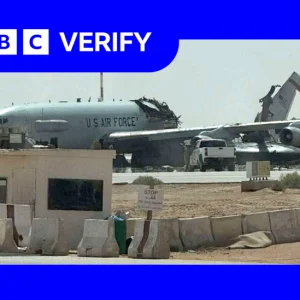
Newly surfaced and verified photographs reveal severe damage to a high-value United States military surveillance aircraft stationed at an air base in Saudi Arabia. The images, which originally circulated on a US military-focused Facebook page, show a Boeing E-3 Sentry plane effectively split in half.
Geolocation analysis confirms the destruction took place at Prince Sultan Air Base, situated roughly 62 miles southeast of Riyadh. Distinct features captured in the photos—including pavement markings, storage units, and nearby pylons—perfectly align with recent satellite surveillance of the facility.
The visual evidence emerges on the heels of a reported Iranian assault on the installation. According to a US official speaking to Reuters on Friday, the attack left 12 American service members injured, two of them critically. Furthermore, reports from the Wall Street Journal indicate that multiple US aerial refueling planes sustained damage during the bombardment. By Sunday, Fars news agency—which holds ties to Iran's Islamic Revolutionary Guard Corps (IRGC)—claimed responsibility for the E-3's destruction, stating it was struck by a Shahed suicide drone.
Flight tracking data from Flightradar24 shows the specific E-3, identified by its tail number in the leaked photos, was last airborne near the base on March 18. Additionally, satellite imagery captured on Friday detected a fire burning on the base's tarmac just over a mile east of the crippled aircraft, though it remains unconfirmed if both incidents stem from the exact same barrage. US Central Command has yet to issue an official statement regarding the compromised jet.
The E-3 Sentry AWACS (Airborne Warning and Control System) is a heavily modified Boeing 707 recognizable by the massive rotating radar dome mounted above its fuselage. This advanced suite allows the military to detect threats from immense distances and serves as a vital airborne command center for coordinating complex combat operations. Originally introduced in 1977, the aircraft model is slated to remain a cornerstone of the US Air Force's fleet until at least 2035.