
English households are preparing for a financial hit this spring as newly released figures indicate that council tax bills will jump by an average of 4.9% for the 2026-27 financial year, comfortably surpassing current inflation rates.
Taking effect on April 1, the hike means the typical Band D property will see its annual bill climb by £111, reaching £2,392.
The Local Government Association (LGA) has stressed that councils are being forced to heavily lean on taxpayers to keep essential local services afloat amid mounting fiscal deficits.
While standard regulations cap tax bumps at 5% for authorities that manage social care, the central government has granted special exemptions to seven councils facing severe financial distress. As a result, residents in Shropshire will face a massive 9% average increase, closely followed by North Somerset at 8.6%.
On the other end of the spectrum, areas including Merton, Rutland, Middlesbrough, and Hartlepool will see the lowest bumps, averaging around 2.5%. However, these are outliers. Data reveals that of the 153 councils tasked with social care responsibilities, a staggering 124 are pushing forward with increases of 4.99% or higher.
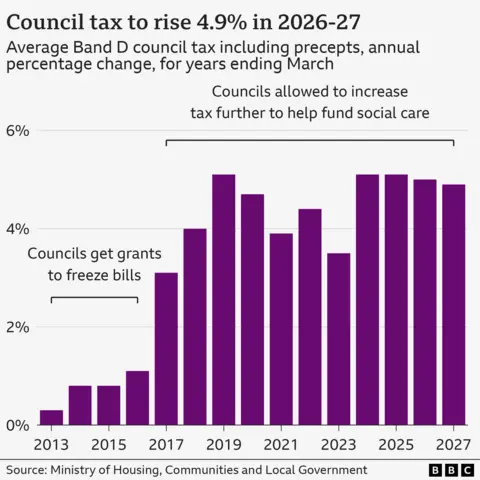
With domestic inflation currently resting at 3%, the impending tax increases represent a real-terms cost hike for residents. Financial experts also warn that further economic pressures could emerge later in the year, driven by broader international instability.
Escalating Costs and Social Care Demands
Council tax is a mandatory property levy across Britain, supplying nearly half of the operational funding for local authorities in England. These funds are vital for keeping day-to-day community services running, from waste management and street cleaning to public libraries and adult care.
Local authorities are currently caught in a fiscal squeeze, battling both skyrocketing operational costs and surging community needs. Owen Mapley, chief executive of the Chartered Institute of Public Finance and Accountancy, notes that the pressure is most intense in areas where councils have strict statutory obligations, such as child and adult social care, special educational needs, and homelessness prevention.
Professor Tony Travers of the London School of Economics highlighted the scale of the crisis, noting that social care alone devours approximately 65% of all council budgets. He pointed out that this demand-driven expenditure is consuming an ever-larger slice of local government funding.
For smaller district councils without social care mandates, tax increases are capped at 3%. However, final household bills can also be inflated by uncapped "precepts"—additional charges levied by parish councils, regional mayors, and emergency services.
The LGA has cautioned that while raising taxes is necessary for immediate survival, it falls short of a long-term cure for the structural funding issues plaguing local governments.
The squeeze is being felt across the wider UK as well. In Scotland, all planned council tax hikes exceed inflation, with some authorities approving spikes of up to 10%. Meanwhile, Welsh households face a 4.8% average increase, and Northern Ireland continues to utilize its distinct domestic rates system.
A New Era for Government Funding
Beyond council tax and local business rates, about one-third of local authority budgets rely on central government grants. This April marks a significant overhaul in how this central funding is distributed across England.
According to the Institute for Fiscal Studies (IFS), the reformed allocation system aims to better link government grants with the actual spending needs of individual regions.
David Phillips, an associate director at the IFS, noted that this shift will inherently create financial "winners and losers" among local authorities. This dynamic, he explained, will likely dictate how aggressively different councils need to hike local taxes in the years to come depending on their new central funding allocation.
In total, the government is preparing to disperse £83.5 billion to English councils for the 2026-27 period, while the devolved administrations in Wales, Scotland, and Northern Ireland will continue managing their own distinct budgets.