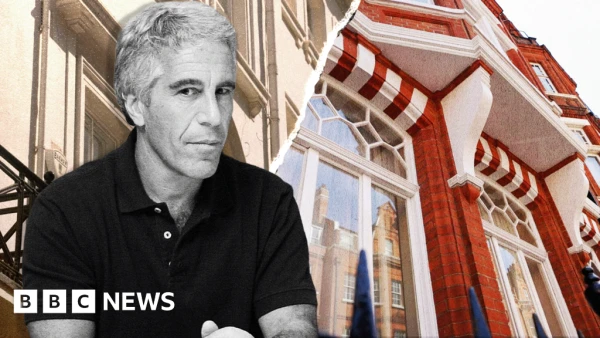
Sex-criminal financier Jeffrey Epstein housed women who say he abused them in several London flats in the years after UK police decided not to investigate him, the BBC can reveal.
Investigators found evidence of four flats, rented in the affluent borough of Kensington and Chelsea, in receipts, emails and bank records contained within the Epstein files. Six of the women housed in them have since come forward as victims of Epstein's abuse.
Many of them — from Russia, eastern Europe and elsewhere — were brought to the UK after the Metropolitan Police decided not to investigate Virginia Giuffre's 2015 allegation that she had been a victim of international trafficking to London. The Met said it followed "reasonable lines of inquiry" at the time, interviewing Giuffre on multiple occasions following her complaint and co-operating with US investigators.
Some of the women housed in the London flats were coerced by Epstein to recruit others into his sex trafficking scheme, as well as regularly transported to Paris by Eurostar to visit him, according to emails in the files.
The BBC searched through millions of pages of records gathered by the US Department of Justice in its investigation of the disgraced financier, and released as part of the Epstein files, in order to piece together the most detailed picture yet of his operation in the UK.
It shows how the operation grew more extensive than was previously known — with more victims, established infrastructure such as housing, and frequent transportation of women across borders — right up to Epstein's death, despite warnings to UK police. We are not publishing any details about the young women to protect their anonymity as the victims of sexual abuse.
Our investigation found British police had other opportunities to open an inquiry into the disgraced financier's activities in the UK, in addition to Giuffre's complaint that she had been trafficked and forced to have sex with Prince Andrew in 2001. Prince Andrew has always denied any wrongdoing.
By early 2020, a second woman had complained to the Met that she had been abused by Epstein in the UK, the BBC has established. It is not clear whether this complaint was acted on. British authorities also knew in 2020, soon after Epstein died in jail awaiting trial, that the financier had rented at least one of the flats identified by the BBC, according to a document in the files.
Tessa Gregory, a human rights lawyer with Leigh Day, told the BBC she was "staggered" no UK police investigation had ever been launched, after we showed her examples of our findings.
"Where there are credible allegations of human trafficking, the UK state, even if no victims come forward, has a positive legal obligation to conduct a prompt, effective and independent investigation," she said.
The Met said: "We recognise our duties within Article 4 of the European Convention on Human Rights and are confident these were fulfilled." Article 4 is the right to freedom from slavery and forced labour.
Kevin Hyland, a former senior detective with the Met Police who was the UK's first Independent Anti-Slavery Commissioner, told us police missed opportunities to investigate the convicted sex offender.
"People are outraged that somebody came forward and said, 'I was trafficked by this man', and yet he was just allowed to carry on. Who in the police made that decision?" he said.
Hyland said that based on his experience investigating human trafficking, officers could have worked with travel companies to keep tabs on the credit cards and IP addresses of people who frequently booked tickets for groups of single women.
"Epstein's dead. But it's clear that he wasn't acting alone. Who else was involved and what offences could they have committed? And of course, importantly, is this still going on with others?" he said.
Jeffrey Epstein, landlord
Just a few months before his arrest on charges of trafficking children for sex, and his death in jail awaiting trial, our investigation found that Epstein was messaging a young Russian woman on Skype who was living in one of the London flats he paid for. He sent her an image which is not included in the files but which seems to have been a picture of himself. The woman jokingly asked who the good-looking man in the picture was.
Epstein said it was her landlord — but said that unlike most landlords, he pays rather than collecting the rent. The woman later went on to ask Epstein for money to pay for her English classes in London and to help buy cutlery and furniture for the apartment. She also asked for visa advice for another Russian woman who was due to come and stay.
The 2019 exchange reveals how Epstein remained in touch with the women he housed in London right up until his arrest and death in jail, and how involved he was in the detail of their lives.
In contrast to the photos released in the Epstein files, which are often decades old, we found the women housed by him in London pictured in Instagram posts, on Russian social media and in high-end fashion shoots. The exterior of the flat mentioned in the Skype chat is pictured in one of these photographs. In the background a doorbell with the name of the building is visible, which enabled us to find the tenancy agreement in the Epstein files.
A shipment of gifts recorded in the files led us to another apartment. Details of yet another, rented in 2018 and 2019, were buried in a 10,000-page credit card bill. It also recorded the daily living expenses of the woman staying there, who had her own card on Epstein's account with a $2,000 (£1,477) monthly allowance. The fourth flat was mentioned in emails between Epstein, one of the women and the letting agents.
Despite their desirable addresses, the flats were sometimes crowded, with the women having to sleep on sofas. On some occasions, Epstein responded angrily when the women complained about the living conditions, emails show.