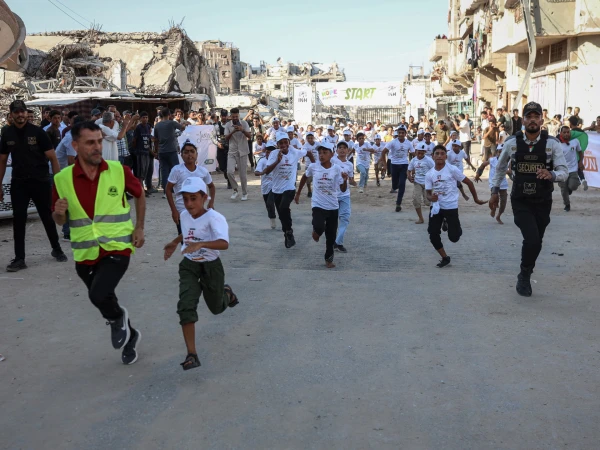
Khan Younis, Gaza Strip – For a fleeting moment, the sharp blow of a whistle offered a welcome distraction from the devastation. Gathering in the southern city of Khan Younis on Friday, dozens of young boys and girls dashed forward in a symbolic race dedicated to the tens of thousands of children orphaned by Israel's ongoing war in Gaza.
Organized by the International Networking for Humanitarian (INH) Indonesia, the "marathon" aimed to draw global attention to the immense struggles facing families who have lost their primary caregivers. Relatives and friends cheered from the sidelines, providing a brief respite in a territory ravaged by continuous bombardment.
For 13-year-old Saif Hijazi, however, participating in the race was impossible. Paralyzed by Israeli artillery shelling that struck near his family's displacement tent in January 2025, the teenager watched from a wheelchair as his younger siblings joined the runners.
"I miss my father every day. He used to take care of everything for us," Saif said. "Since I was injured, I can’t walk or move on my own anymore. I just want my life to get better."
Saif's father, Rami, was killed in a strike on their northern Gaza home in January 2024. Since then, the burden of survival has fallen entirely on his 33-year-old mother, Warda. Tasked with managing Saif's complex medical needs—including kidney paralysis—alongside caring for nine-year-old Sarah and 10-year-old Ammar, Warda battles daily to secure basic necessities while living in a temporary shelter in al-Zawaida.
"Everything has become my responsibility," Warda shared, noting that the compounded trauma of losing her husband and witnessing her son's severe injury pushed her into severe depression. "Orphaned children are living through a very difficult reality. They do not only need food; they need someone to make them feel safe, to embrace their grief and give them the love they lost."
A Staggering Crisis
The scale of the orphan crisis in Gaza is unprecedented. Local health officials report that more than 73,000 people have been killed since October 2023. According to UNICEF, upwards of 58,000 children have lost at least one parent, and an estimated 17,000 are completely unaccompanied or separated from their families, creating massive psychosocial and protection emergencies.
Mohammed Yassin, INH Indonesia’s project coordinator, emphasized that losing a family's main provider dramatically escalates the struggle to secure essentials like food and clean water in an already devastated economy.
"Orphans are always among the most affected groups in wars," Yassin said. "Through these activities, we try to remind the world and encourage people to support them and provide sponsorship that can help them in their daily lives."
For widowed mothers like 43-year-old Samah Abu Amra, that support is desperately needed. After her husband was killed in Khan Younis during the first year of the war, she became the sole provider for her five children, who range in age from seven to 19.
Abu Amra noted that the current scale of devastation has left many orphans without the safety nets that existed during previous escalations.
"I cannot provide everything they need," Abu Amra explained. "An orphan needs to be seen and heard. Their needs must be met. They need someone who asks about them and cares for them, not just temporary assistance."
As the humanitarian crisis deepens, organizers and grieving families share a unified plea: for the international community to recognize the invisible wounds of Gaza's youngest survivors and provide the enduring support they need to rebuild their shattered lives.