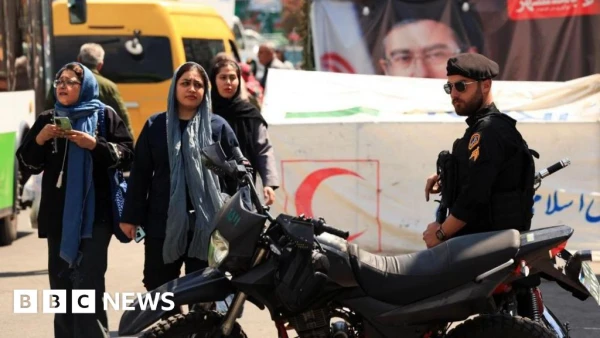
In northwestern Iran, spring blossoms emerge alongside a tentative ceasefire, drawing Iranians back to their homeland amid cautious hope and deep-seated fears. At border crossings, returnees share starkly different perspectives on the recent conflict.
"I stayed with my son in Turkey for a month," a banker recounts, noting that in his northern city, "airstrikes mainly hit military targets, not homes." His summary reflects the two-week truce that pauses five weeks of devastating warfare, with its expiration looming just days away.
Nearby, an elderly woman in a headscarf voices deeper anxieties. "I'm a bit scared," she confesses, her face etched with worry as she speaks of young Iranians suffering from shelling in residential areas and threats from paramilitary forces patrolling the streets. "It's all in God's hands," she murmurs, looking skyward.
Others express more immediate geopolitical concerns. "Of course, the ceasefire won't hold," declares a young woman in a bright red jacket. "Iran will never give up its control of the Strait of Hormuz." This sentiment echoes as travelers cross into Iran, where one man exclaims about the current calm, "Trump will never leave Iran alone; he wants to swallow us!"
The journey to Tehran reveals the conflict's tangible impacts. Vehicles detour along winding rural roads after the main bridge linking Tabriz with Tehran collapsed under missile fire last week. This destruction comes despite U.S. and Israeli insistence they target only military sites, a claim contradicted by visible damage to civilian infrastructure that has drawn warnings from legal scholars about potential violations of international humanitarian law.
Military targets are evident too, including a flattened barracks of the Islamic Revolutionary Guard Corps outside Tabriz, where a huge flag drapes across ruined concrete pillars. The targeting raises questions about the boundaries of warfare, particularly after recent U.S. threats.
"We could take out every one of their bridges in one hour," the U.S. president recently warned, adding, "we don't want to do that."
This apocalyptic language resonates at a centuries-old roadside caravanserai, its vaulted stone ceilings and stained-glass windows offering glimpses of Iran's ancient civilization—a civilization some fear could be threatened by escalating conflict.
Modern Iran reveals itself in contrasting images: some women wear veils and scarves while others, of all ages, go bare-headed—a legacy of recent protests where women refused to "turn the clock back" despite ongoing strict modesty laws.
Yet more pressing concerns dominate the political landscape. New highway banners display portraits of Iran's three supreme leaders since the 1979 revolution, including Ayatollah Ali Khamenei, who was assassinated in the war's opening salvos, and his successor Mojtaba Khamenei, reportedly seriously injured in the same attack and unseen publicly since.
Behind the scenes, diplomatic efforts intensify. Recent marathon talks in Islamabad brought together U.S. and Iranian officials for 21 hours of negotiations, with Pakistan's Army Chief arriving in Tehran to accelerate mediation. White House officials confirm discussions about a second round of talks, with reports suggesting the ceasefire might be extended.
"A full end to war, lifting sanctions, and retribution of damages of U.S.-Israeli attacks on Iran," an Iranian foreign ministry spokesman outlined as Tehran's demands.
Washington's position includes firm red lines: no nuclear enrichment for Iran, dismantlement of enrichment facilities, removal of highly enriched uranium stockpiles, opening of the Strait of Hormuz, and ending funding for regional proxies.
Sources indicate Tehran has rejected a 20-year moratorium on nuclear enrichment, proposing instead a five-year pause similar to pre-war offers. Iran also resists handing over its 440kg stockpile of highly-enriched uranium, sticking to earlier concessions to dilute material dangerously close to weapons grade.
Despite U.S. pressure, including a blockade of Iranian vessels through the Strait of Hormuz, Tehran shows no signs of capitulation. A senior Iranian military commander recently threatened to halt "any exports or imports" through key regional waterways if pushed further.
From Washington come assessments that "America's shooting war—or at least the worst of it—could be over for now." Inside Iran, people take things day by day, their views on the country's future as varied as their experiences of the conflict.
It's only mid-April, yet Iranians have already endured nationwide protests crushed with lethal force, an unfinished external war, and domestic restrictions including widespread internet blackouts. Many now wonder whether any potential deal might finally lift crippling sanctions and bring lasting peace to a nation weary of conflict.