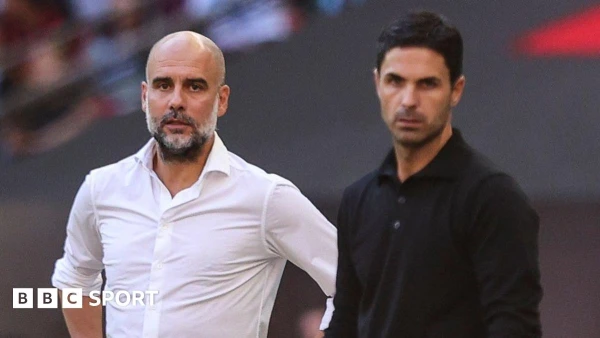
Former colleagues. Master and apprentice. Title rivals.
Pep Guardiola and Mikel Arteta's relationship has spanned decades, evolving alongside their managerial careers. The two Spaniards will face off at Etihad Stadium on Sunday in what many consider a Premier League title decider. A victory for Guardiola's Manchester City would narrow the gap to Arteta's Arsenal to just three points, with City holding a game in hand.
Their connection began in 1997 when Arteta joined Barcelona's academy, meeting his idol, then-captain Guardiola. Though their time as teammates was brief, a lasting friendship formed. However, communication between the managers cooled significantly after Arteta left his role as Guardiola's assistant at Manchester City in 2019 to take charge of Arsenal.
While Guardiola's other former assistants maintained closer contact, Arteta stepped away, creating a period of silence between them. Guardiola values continuous give-and-take in relationships, and without clear expression, bonds can fracture even without overt conflict. Arteta, known for moving forward independently of past professional ties, eventually re-established contact in the past year, easing tensions. Though neither will reveal who made the first call, they are speaking again.
Now competing for the same trophies, both recognize the strength of their friendship while navigating the solitary pressures of managing top football clubs.
Guardiola's influence on modern football is profound. His Barcelona teams of the late 2000s and early 2010s became a Sunday evening ritual for coaches across Europe, who spent 90 minutes trying to decipher what they were witnessing.
"At first I didn't understand what he was doing," said Andy Mangan, an opposition scout for Brazil. "But every week he would identify a space to attack, and every Sunday you watched those players play with joy. We were kids but it was inadvertently a vital learning period of so many coaches' lives."
Guardiola not only built successful teams but created a new way of winning. Pep Segura, former director of football at Barcelona, explained: "Of the four phases of the game – attack, defence, offensive transition, defensive transition – until Pep arrived, most teams structured themselves defensively and took whatever the game gave them. They were reactive. Guardiola arrived and said, 'no, we will think about how we play from the way we attack.'"
Football reorganised around possession, positioning, and numerical superiority, with the ball at the centre of everything. This triggered a response that shaped Arteta's coaching development.
"Teams started asking themselves how to counter this… with pressing and, above all, quick transitions," Segura added.
The game evolved in response to Guardiola's approach; transitions became sharper, physical demands increased, and players had to think more critically about their actions. Arteta grew up as a coach in this transformed landscape.
Those who worked closely with Arteta during his time as Guardiola's assistant at Manchester City describe him not merely as an apprentice but as a "formidable dance partner," fully immersed in the intensity of Guardiola's methodology. Guardiola valued his input highly, particularly in raising training standards regarding intensity, aggression, and competitive detail.
Having played for Everton and Arsenal, Arteta provided Guardiola with insights into the Premier League's tempo, refereeing, fan emotional volatility, and physical demands. However, he was never a strict adherent to Guardiola's ideas. While aligned in principles during his assistantship, Arteta was already developing his own tactical philosophy.
"Unlike Pep, who had to learn transitions which he started doing in Germany, Arteta was born and grew up with them. He played in England, he knows them," Segura noted.
Guardiola's teams have traditionally dominated two phases: attacking organisation and defensive transition, controlling matches through possession and reacting immediately when the ball is lost. Arteta's early Arsenal teams emphasised control but eventually adapted.
Former Celta Vigo assistant David Martinez observed: "I think he understood that to be competitive and aspire to win titles – offensively there are teams with more resources and talent than Arsenal. He understood he had to base his improvement on dominating everything."
Robert Moreno, former Spain coach, argued that Arteta developed his own voice, producing one of Europe's most effective units. Mangan added: "What's fascinating with Mikel is that he's understood where the game is going very quickly – duels, set-pieces, long throws… all the things that now decide matches."
However, Arteta's reliance on rehearsed mechanisms comes with a cost. The more a team depends on precision execution, the more it struggles when that execution falters. This marks a key distinction from Guardiola, whose elite teams combine structured intelligence with players capable of improvising when patterns break down.
At times, Arsenal are perceived as more rigid, with players remaining locked into roles rather than breaking structure to solve problems. While Arsenal learned to compete at the highest level, Guardiola continued to evolve.
"He starts incorporating new concepts," said Segura. "Above all defensive transition, that's where he evolves enormously. Arteta incorporated more physical profiles than Pep. Pep seeks more technical players… Arteta looks for strength, speed, power."
Despite differences, convergence points remain. "Both have looked for pieces to improve the offensive transition," Segura added, citing City's acquisition of Erling Haaland and Arsenal's pursuit of Viktor Gyokeres.
The comparison becomes most revealing in how each manager responds to difficulty. Arteta is currently in that moment, having built a team capable of competing with the best but seeking the final step of consistent top-level winning. When results falter, the temptation to change under external pressure is ever-present. Yet Arteta has doubled down on his ideas, demanding more from his players within the same framework.
In elite sport, losing is part of the process. The challenge lies in evolving and trying again with equal or greater effort. Guardiola has lived this cycle repeatedly, returning to his principles and expanding them after setbacks.
Former Burnley, Everton, and Nottingham Forest manager Sean Dyche witnessed this resilience firsthand: "In difficult times, Pep didn't panic. He adjusted, but he stayed true to what he believes."
As Sunday's showdown approaches, the narrative extends beyond a mere title decider. It represents the culmination of a relationship that has weathered silence, rivalry, and mutual respect, highlighting two distinct yet interconnected approaches to football management at the highest level.