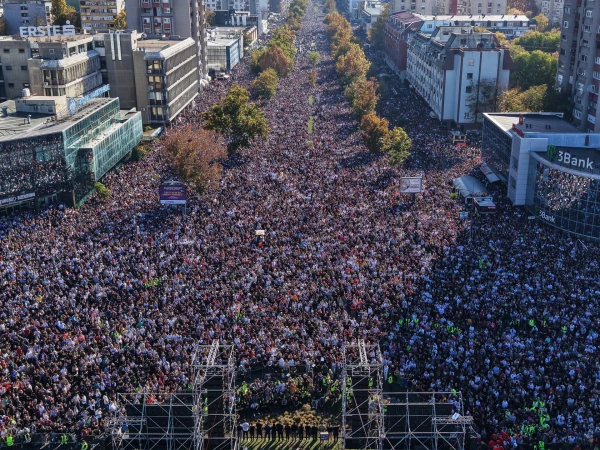
Two years after a catastrophic roof collapse at a Novi Sad train station claimed 16 lives, the resulting wave of public grief and outrage has fundamentally reshaped the nation's political landscape. What began as a local demand for accountability quickly snowballed into a fierce, student-led protest movement, culminating in a seismic election that ousted Serbia's ruling government.
Here is a timeline of how a devastating infrastructure failure led to a historic political revolution.
November 1, 2024: The Tragedy A newly renovated concrete canopy at Novi Sad's railway station collapses, killing 14 people instantly and critically injuring three others. Two more victims would succumb to their injuries in the ensuing months, raising the final death toll to 16. The disaster immediately exposes deep public mistrust, shining a spotlight on alleged state corruption, shoddy construction standards, and opaque public spending.
November 5 – 21, 2024: Uprising and Arrests Within days, thousands flood the streets of Novi Sad to demand justice. Tensions boil over into clashes with law enforcement, resulting in dozens of arrests and significant damage to City Hall. Critics are quick to note that while the state rapidly prosecutes demonstrators, the official probe into the canopy collapse moves at a crawl.
Escalating their demands, opposition members and citizens blockade Novi Sad's court and prosecutor's offices for three days in mid-November, facing off against riot police. Bowing to the mounting pressure, officials finally arrest 11 individuals on November 21, including former Construction Minister Goran Vesic.
Late 2024: Campus Sit-Ins and Partial Disclosures Following an attack on students and faculty during a Belgrade memorial service, university students launch coordinated sit-ins. They demand the prosecution of their attackers, the release of detained peers, and full transparency regarding the station's renovation contracts. By December 11, the government releases partial reconstruction documents. Protesters, however, reject the 195 documents as a half-measure, demanding criminal charges for the contractors.
December 2024 – January 2025: Legal Maneuvers Prosecutors indict 13 people for crimes against public security and improper construction. Controversially, courts reduce the detentions of key figures like Vesic and railway director Jelena Tanaskovic to mere house arrest, drawing intense public ire. By mid-January, a separate organized crime probe is launched in Belgrade, investigating Vesic, former Trade Minister Tomislav Momirovic, and over a dozen others for alleged financial fraud and money laundering tied to the railway project.
Early to Mid-2025: Political Casualties and Mass Mobilization After ruling party loyalists assault arts students in late January, Prime Minister Milos Vucevic resigns—the biggest political casualty of the crisis at that point. Yet, the unrest continues to grow. In March, the preemptive arrests of 13 activists ahead of a planned Belgrade rally spark widespread outrage, culminating in hundreds of thousands marching through the capital on March 15. By June, relentless pressure from state security forces drives several protest leaders into European exile, where they continue to rally international support.
September – October 2026: The Political Upset As snap parliamentary elections loom in October, the grassroots protest movement transforms into a formidable political entity: the "Student List-Students Win" coalition, uniting academics, legal experts, and youth activists.
On September 27, longtime leader Aleksandar Vucic resigns the presidency to spearhead his party's electoral campaign. In a strategic bid to quell public anger on his final day in office, he pardons all prosecuted activists, allowing those in exile to return safely.
The gamble fails. In late October, amidst the highest voter turnout in over three decades, Vucic concedes defeat to the Student List coalition. As a new generation takes power, delivering justice for the victims of the Novi Sad railway tragedy remains at the very center of their mandate.