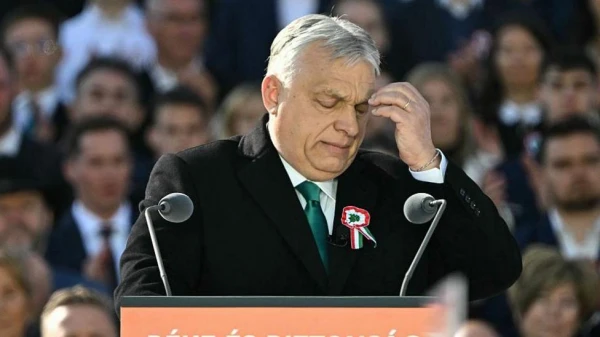
Viktor Orbán, Hungary's prime minister for 16 years, faces his toughest electoral test yet in upcoming elections, with polls suggesting he may be defeated by former party insider Péter Magyar. No serving EU leader has held power longer, but Orbán's grip appears to be weakening.
Since 2010, Orbán has transformed Hungary into what the European Parliament has called a "hybrid regime of electoral autocracy." He describes his system as "illiberal democracy" or "Christian liberty," while his U.S. allies in the Maga movement call it "national conservatism."
Orbán has repeatedly clashed with the European Union over Ukraine, blocking vital funding for Kyiv and accusing Ukraine of trying to drag Hungary into war with Russia. He remains Vladimir Putin's strongest partner within the EU and has received endorsements from former U.S. President Donald Trump and Vice-President JD Vance, who recently visited Budapest to urge voters to "stand with Viktor Orbán."
Within the EU, Orbán's closest allies come from the radical and hard right. Polish Prime Minister Donald Tusk observed that "Orbán and his foreign minister left Europe long ago," referring to Foreign Minister Péter Szijjártó's admission that he shared details of EU meetings with Russian counterpart Sergei Lavrov.
Orbán's personal charisma has been key to his success, but polls suggest many supporters have grown tired of him and corruption allegations surrounding his party. He appeared rattled when booed during a recent campaign speech in Győr—a stark contrast to the leader who once stacked sandbags alongside volunteers during a 2010 environmental disaster.
Orbán first emerged as a law student in the late 1980s, founding Fidesz (Alliance of Young Democrats) as the Soviet Union began to collapse. His audacious seven-minute speech to 250,000 Hungarians in Heroes' Square declared, "If we believe in our own power, we are able to finish the communist dictatorship."
Reflecting on those words a decade later, he said he had "exposed everyone's silent desire for free elections, and an independent and democratic Hungary." Yet Hungarian-born journalist Paul Lendvai argues Orbán has moved "from one of the most promising defenders of Hungarian democracy into the chief author of its demise."
Born in 1963 in the village of Felcsut, Orbán grew up without running water in a communist household. He recalled being beaten regularly by his father, describing him as "a violent man." Nothing in his childhood suggested he would challenge the regime—he attended grammar school and was involved in the Young Communist League.
Football was his main passion, playing for local club FC Felcsut. He remains enthusiastic about the sport, inaugurating the controversial Pancho Arena in his hometown in 2014.
After his 1989 speech, Orbán studied briefly at Oxford on a scholarship from Hungarian-born billionaire George Soros—a benefactor he would later turn against. He abandoned his studies to campaign in 1990 elections, where Fidesz won 22 seats with Orbán topping the party list.
Political scientist Zoltan Lakner believes Orbán shifted ideology in the late 1990s, realizing "to gain political success he had to turn his back on liberalism and transform his party into a nationalist, anti-liberal political force." At Oxford, he befriended conservative philosopher Roger Scruton, possibly planting seeds for this transformation.
In 1998, Orbán led Fidesz to victory, becoming Europe's youngest prime minister at 35 and taking Hungary into NATO in 1999. After electoral defeats in 2002 and 2006, he declared, "The nation cannot be defeated," learning lessons that would shape his political approach.
Now 62, Orbán faces what may be his most significant political challenge yet, with his long tenure potentially ending as Hungary heads to the polls.