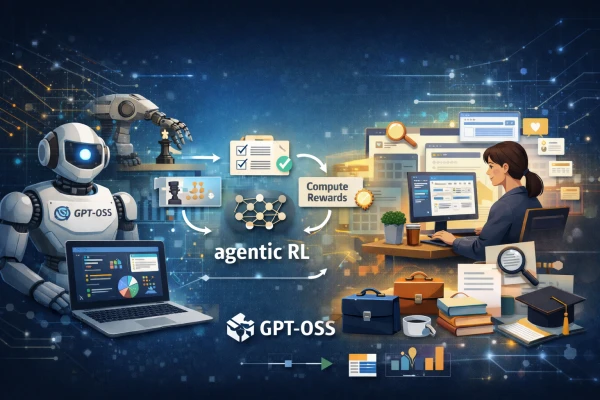
In a recent retrospective, developers shared practical insights from applying reinforcement learning (RL) to train GPT-OSS models for agentic tasks. The team faced challenges in reward design, training stability, and balancing exploration with exploitation.
"The key was to design a reward function that captures real-world task success without overfitting to proxy metrics."
They emphasized the importance of iterative reward shaping, using a combination of sparse and dense rewards to guide learning. Early experiments with pure sparse rewards led to slow convergence, while overly dense rewards caused the agent to game the system.
Another critical factor was environment diversity. Training across varied simulated scenarios helped the model generalize better, avoiding brittle policies that failed on unseen tasks. The team also found that periodic retraining with updated environment distributions kept the agent robust.
On the infrastructure side, distributed training with experience replay and asynchronous updates reduced wall-clock time. However, they noted the need for careful tuning of hyperparameters like learning rate and batch size to prevent instability.
Despite the progress, the authors caution that agentic RL remains costly and data-hungry. Future work may explore meta-learning and self-play to improve sample efficiency.