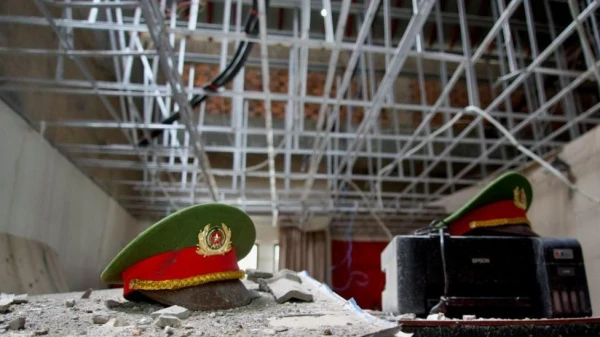
In the eerie silence of a bombed-out Cambodian casino complex, the remnants of a massive international fraud operation lie scattered across six floors. The BBC has gained exclusive access to Royal Hill casino in O Smach, a border town now occupied by Thai soldiers, revealing a sophisticated scam compound that operated in near-total secrecy until recent military action.
Walking through the unlit corridors, each room presents a different fraudulent facade. One contains a perfect replica of a Vietnamese bank, while another mimics an Australian police station complete with official-looking uniforms. Chinese motivational slogans adorn the walls, including one declaring "Money Coming From Everywhere," while counterfeit hundred-dollar bills litter the floor.
"This was a massive scam compound where thousands of people from different countries worked under a harsh regime, defrauding victims worldwide of their savings," reports Jonathan Head, the BBC's South East Asia Correspondent.
The compound was abandoned in December when Thai air forces bombed the site during a brief border conflict. Workers fled so hastily they left behind half-eaten meals and personal belongings, creating a time capsule of their sudden departure.
Thai military officials brought journalists to the site to demonstrate the scale of Cambodia's scam industry. "We need international help in shutting this scourge down," they stated, while acknowledging the visit also served to justify their December air attacks on Cambodian targets.
Remarkably, Royal Hill operated almost entirely under the radar until Thai forces took control. While the nearby O Smach Casino has drawn attention for scam worker abuses, Royal Hill's owner Lim Heng maintained a low profile despite holding the prestigious Neak Oknha title awarded by former Prime Minister Hun Sen—a designation requiring a minimum $500,000 donation.
Cambodia's border casinos have become hubs for international crime syndicates, particularly after the government banned online gambling in 2019 under Chinese pressure. When the COVID-19 pandemic halted cross-border travel, these operations pivoted to online fraud, luring young workers from around the world with promises of legitimate employment.
Documents recovered from the rubble reveal the operation's brutal efficiency. Workers faced corporal punishment for failing to meet daily targets—five cane strokes for not establishing a "lead" with a potential victim, and ten strokes after three unsuccessful days. Casual conversation between colleagues or failure to share personal photos for building victim trust resulted in similar penalties.
Wilson, a Ugandan man recruited under false pretenses, described the operation's mechanics: "You're supposed to portray a 37-year-old rich woman looking for a husband. You chat with older Americans, build emotional connections, then lure them into buying products."
Workers endured 15-16 hour days following scripts provided by Chinese bosses, using AI to alter their voices and appearances. Even during the Thai bombardment, they were forced to continue working, running outside when bombs shook the building only to return to their stations moments later.
The compound maintained strict control over every aspect of workers' lives, requiring permission for bathroom breaks and documenting each toilet visit on official forms. As one Thai soldier surveying the damage noted, "This wasn't just a workplace—it was a prison designed to extract maximum profit through psychological manipulation and physical coercion."