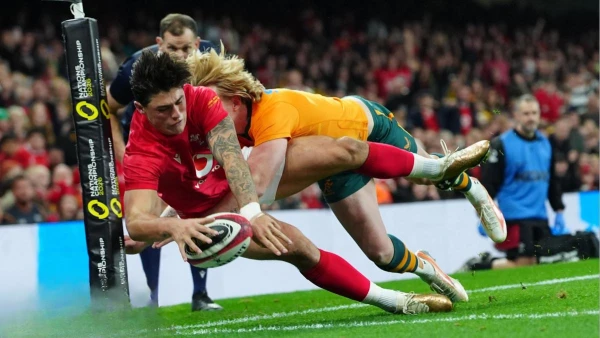
Louis Rees-Zammit’s NFL stint transforms Wales’ speedster into a world-class winger
Louis Rees-Zammit has always been fast. But now, the Wales wing is something far more dangerous: a rugby player who combines blistering pace with the strength and tactical nous of a seasoned professional.
The transformation was on full display during Wales’ clash with Australia at the Principality Stadium last weekend. As Rees-Zammit glided past defender Harry Potter, leaving the Australian sprawled on the turf, it wasn’t just raw speed that undid him—it was a masterclass in evasion. A deft sidestep, a burst of acceleration, and Potter’s desperate dive came up empty. The try that followed, set up by Blair Murray, was a testament to Rees-Zammit’s newfound ability to exploit space before defenders could react.
"If you do that shimmy and stand any player up, they can’t recover," said Alex Cuthbert, the former British and Irish Lions wing who now coaches Rees-Zammit at Bristol Bears. "Literally can’t recover."
Cuthbert has watched Rees-Zammit evolve from a lightning-fast but raw talent into a player with the strength and technique to dominate in open play. Much of that development stems from his 18-month stint in the NFL with the Kansas City Chiefs and Jacksonville Jaguars, where he honed his athleticism and refined his movement.
"If you do that shimmy and stand any player up, they can’t recover." — Alex Cuthbert
"Last season, he looked like a running back—heavy, powerful," Cuthbert explained. "This year, he’s more of a wide receiver. He’s got the best of both worlds now."
Pat Lam, Rees-Zammit’s coach at Bristol Bears, estimates the wing returned from America eight or nine kilograms heavier but with his speed intact—if not enhanced. "He still had his pace, but he needed to adjust to being a bigger man," Lam said. The extra weight has given him the power to shrug off tackles and the agility to change direction in an instant.
Rees-Zammit’s journey hasn’t been without experimentation. Before his NFL detour, he had established himself as a reliable winger. But upon his return, he toyed with the idea of playing full-back—a role that demands a different kind of versatility. "He wanted to try it," Lam recalled. "But we had to go through that process for him to say, ‘Pat, I’m a world-class winger. I’m a world-class finisher.’ And I agreed."
The numbers back up the hype. In five Premiership games this season, Rees-Zammit has already matched his five-try tally from 10 appearances last year. Against Japan in November, he dismantled the defense, beating 13 defenders and making more line breaks in a single match than he did in the entire Six Nations campaign.
His impact extends beyond his own performances. Wales’ resurgence under new tactics has given Rees-Zammit the platform to thrive. The team’s forward pack is generating more momentum, while scrum-half Tomos Williams has perfected the art of the sharp, early pass—bypassing defenders to put Rees-Zammit into space.
"As a winger, you rely on your boys inside you," Cuthbert noted. "Blair Murray’s ability to engage defenders before releasing Rees-Zammit was crucial in that try against Australia."
Even the smallest details reflect Rees-Zammit’s growing influence. After scoring a disallowed try against the Wallabies, his first instinct wasn’t celebration—it was fixing his hair. The moment underscored his awareness of his image, a trait that has made him Welsh rugby’s most marketable star.
At the Principality Stadium, the anticipation before he receives the ball is palpable—a low hum of excitement followed by the rattle of seats as fans rise in unison. The thrill isn’t just in the speed; it’s in the promise of what’s to come.
Rees-Zammit’s evolution from a promising talent to a world-class winger is complete. And for Wales, that’s a game-changer.