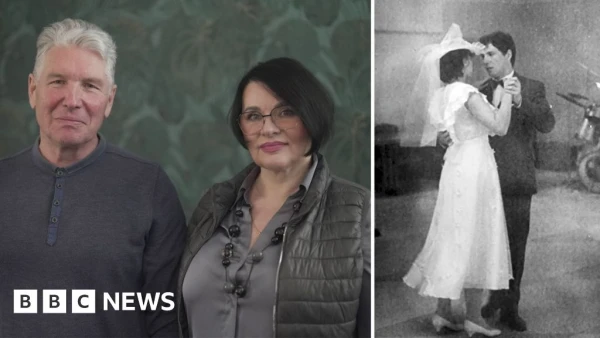
As midnight passed on April 25, 1986, Iryna Stetsenko lay awake with pre-wedding nerves, her freshly painted nails a small luxury before her big day. Nearby, her fiancé Serhiy Lobanov slept soundly on a kitchen mattress in an apartment crowded with wedding guests. Neither could have imagined that the rumbling sound that shook their windows was the beginning of the world's worst nuclear disaster, unfolding just 2.5 miles from their planned future home.
"It was as if a lot of planes were flying overhead, everything was humming and the glass in the windows shook," Iryna recalls of those first moments when reactor number four at the Chernobyl power plant exploded.
Serhiy, a 25-year-old power plant engineer, dismissed the tremor as a minor earthquake and returned to sleep. Iryna, a 19-year-old trainee teacher, tried to ignore her growing anxiety. Both were looking forward to building their life together in Pripyat, the modern Soviet city constructed specifically for Chernobyl workers and their families.
When morning dawned gloriously sunny, Serhiy woke with wedding day excitement. His first errands revealed unsettling signs: soldiers in gas masks patrolled the streets, crews washed pavement with foamy solutions, and colleagues from the plant whispered about an emergency call-out. From a friend's high-rise apartment, he spotted smoke rising ominously from the direction of the power plant.
"I felt a bit anxious," Serhiy admits. Drawing on his nuclear training, he wet fabric and placed it across the apartment entrance to catch radioactive dust—a precaution that would prove tragically prescient.
Meanwhile, Iryna prepared at her mother's apartment, where concerned neighbors kept calling through the night with vague warnings about "something terrible" happening. Soviet authorities maintained strict information control, assuring citizens through brief radio announcements that all planned events should proceed normally. Schools remained open, children attended classes, and wedding preparations continued as scheduled.
The ceremony at the Palace of Culture proceeded with traditional solemnity, the couple standing on cloth embroidered with their names as they exchanged vows. But the celebratory atmosphere had evaporated.
"Everyone understood that something had happened, but no one knew the details," Serhiy says of the wedding banquet that felt "sad" rather than joyful.
Their carefully practiced first dance—a traditional waltz—quickly dissolved into a desperate embrace as reality intruded on their celebration.
"From the first steps we went out of rhythm," Iryna remembers. "We just hugged each other and moved in the hug."
Exhausted but finally married, the couple retreated to their friend's apartment, only to be awakened in the early hours by urgent knocking. An evacuation train would depart at 5 a.m., they were told. Iryna had only brought a flimsy dress for the second day of celebrations, so she pulled her wedding gown back on and ran barefoot through puddles to her mother's apartment to change clothes, her wedding shoes having given her blisters.
As their train pulled away in darkness, the newlyweds watched the glow of the collapsed reactor illuminating the sky.
"It was as if you were looking into the eye of a volcano," Serhiy describes the haunting sight.
Authorities described the evacuation as "temporary," but Serhiy notes with bitter irony: "We left for three days, but ended up going for our entire lives."
The Soviet Union's delayed response to the disaster meant that firefighters and plant workers had already spent hours battling the toxic blaze without proper protection. Nikolai Solovyov, a lead engineer working in the turbine hall when the reactor exploded, recalls the moment catastrophe became personal.
"It was like an earthquake beneath us," he says. "We saw the roof collapsing... A blast of air came towards us and brought all this black dust."
When radiation monitors showed levels "off the charts," the true scale began to emerge. Solovyov found a colleague vomiting—an early sign of radiation sickness—on one of the turbines. "He was one of the first to die," he says quietly.
The official death toll lists 31 immediate fatalities, but the long-term consequences remain bitterly contested, with estimates ranging from 4,000 to tens of thousands of eventual deaths from radiation exposure. A massive containment operation mobilized hundreds of thousands of "liquidators" from across the Soviet Union, many working by hand when radiation disabled machinery.
Forty years later, the radioactive ruins of Chernobyl sit in an active warzone, while Iryna and Serhiy have rebuilt their lives in Berlin—uprooted for a second time, this time by conflict rather than nuclear disaster. Their wedding, intended as a celebration of new beginnings, became instead a poignant marker of lives forever changed.
"We really can't be one without the other," Iryna says after four decades of marriage forged in extraordinary circumstances.
Their story stands as a testament to love's resilience amid catastrophe, a personal narrative woven into one of history's most devastating technological failures.