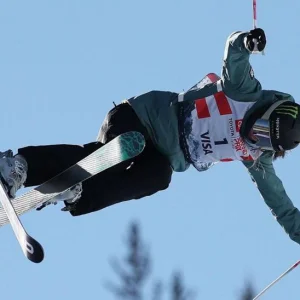
Plummeting 40 feet onto an icy surface isn't just a nightmare for elite winter athletes—it's just another day at the office. For the competitors gearing up for the upcoming Milan-Cortina Olympic Games, learning how to compartmentalize the terror of high-altitude acrobatics is just as vital as sticking the landing.
"The biggest challenge of my sport is definitely overcoming the fear," explains 23-year-old Zoe Atkin, a Team GB medal hopeful preparing for her second Winter Olympics.
Competing in the ski halfpipe, Atkin routinely launches herself out of a 22-foot deep trench, executing dizzying, high-amplitude tricks. To master her mindset, Atkin leans on her academic background. As a student of symbolic systems at Stanford University, she blends cognitive science and computer science to decode the human brain.
"Being able to understand fear from a biological process has helped me on the slopes," Atkin shares.
Surprisingly, competition day brings her the least amount of anxiety, which she mitigates with morning meditation. The true terror, she notes, surfaces during practice when attempting untested maneuvers. Spectators might label these athletes as adrenaline junkies, but Atkin insists their craft is deeply calculated.
Her journey is deeply intertwined with her older sister, Izzy, who secured a historic slopestyle bronze for Britain in 2018. Watching her sister's triumph in Pyeongchang ignited Zoe's Olympic dreams. However, the sport's brutal reality forced Izzy into early retirement following a severe pelvic fracture before the 2022 Games.
Zoe has largely dodged such catastrophic injuries while ascending to dominance, securing X Games gold and a string of World Cup podiums this season. Yet, she emphasizes that past success doesn't erase future anxiety.
"No matter how established you are, there's always a comfort zone you need to push to progress," she notes, reflecting on her work with sports psychologists to break through mental barriers.
Part of her training even involves learning how to crash safely, deliberately falling on her side to prevent worse injuries during over-rotations.
Fellow Team GB skier Kirsty Muir, 21, understands the physical toll of the slopes all too well. A specialist in slopestyle and big air, Muir spent a grueling year sidelined after a December 2023 scan revealed a torn cruciate ligament caused by repeated impacts to her knee.
Now back to her winning ways at the World Cup and X Games, Muir acknowledges that fear peaks when athletes lose control of their environment.
"I've had skis come off my feet or my goggles come over my eyes when about to jump, and I've been flying through the air without skis on my feet. That is a weird feeling," Muir recalls. "We are good at adapting to situations, not thinking about it until it happens. There is no point in worrying - be prepared, then adapt."
To help their athletes stay remarkably calm under intense pressure, governing body GB Snowsport has introduced unconventional training methods, including freediving and specialized breathing exercises.
When it comes to the final moments before launching down a ramp, Atkin and Muir rely on wildly different coping mechanisms. Atkin uses rationalization and mindfulness, reminding herself that fear is merely a logical bodily reaction to extreme danger.
Muir, however, supplements her meticulous step-by-step training with a touch of nostalgia and rock and roll. Alongside her carefully curated playlist—featuring "The Pretender" by the Foo Fighters—she carries a deeply sentimental token.
"I have a lucky snood - the face masks people use when they ski - always on my person," Muir reveals. "I got it off one of the skiers I admired at the dry ski slope when I was younger, and I've always had it with me."