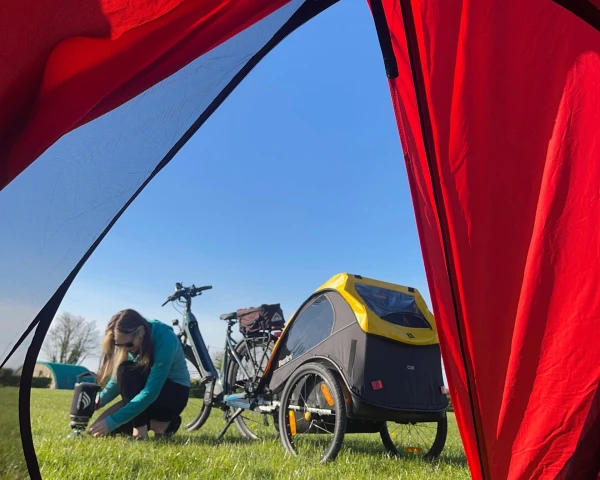
Skylarks call out a cascading trill as I pedal between the pink and white hawthorn blossoms, making my path look like a May Day parade. On the outskirts of Oxford, a city I thought I knew well, following National Cycle Route 57 on an e-bike, it feels as though I’ve discovered a secret passageway.
This year, the Camping and Caravanning Club (CCC) turns 125. I’m celebrating with a 60-mile cycling and camping trip, leaving from Oxford—where the organization was born—to Walton-on-Thames, staying at one of the oldest campsites in the CCC network.
The CCC began as the Association of Cycle Campers. Founder Thomas Hiram Holding, already a keen camper, visited his friend Rev EC Pitt-Johnson’s Oxford home in 1901, and they decided there was enough demand to form a club. They elected each other president and secretary respectively, and the rest is history.
Back then, Holding rode a “safety cycle”—not unlike modern bikes—and invented much camping gear, from early lightweight tents to cycle touring bags. “Holding understood the health and wellbeing benefits people gained from camping,” says Jo Cartwright, CCC archivist. “I think he would’ve embraced any new form of transport.”
Today, motorhomes and caravans dominate, but the CCC assures me humble tents are still welcome. With mine stowed on my e-bike, I set off, breaking my journey with an overnight stop at Bella Vista Camping in Radnage, a family-run club site on the Chiltern Cycleway.
Quiet roads lead east from Oxford toward Wheatley and Thame, where I grab a sandwich and coffee at the Old Fisherman. Then I continue on the Phoenix Trail (part of Route 57), a disused railway track to Princes Risborough. Red kites replace skylarks as I glide away from traffic, passing the old station building at Bledlow and the abandoned platform at Towersey Halt, closed since 1963.
Before founding the Association, Holding camped by canoe in Ireland—until a friend in England announced a tandem camping trip and asked for help attaching kit. Holding later wrote, “We succeeded,” and declared in his 1897 book Cycle and Camp, “There was something in it.”
Bella Vista Camping still has a huge field for tents, next to a paddock of Soay sheep and alpacas, with hot showers and proper toilets. After dinner at the Crown Pub and a quiet night’s sleep while my bike battery charged, I’m ready for the next leg to Walton-on-Thames.
Opened in 1913, the Walton CCC campsite was described in a 1963 Golden Jubilee booklet as a place of “homemade tents, bamboo poles, hurricane lamps and wood fires.” Curious, I leave the Chilterns and bear south through High Wycombe, Marlow, Cookham, and narrow cycle paths between Maidenhead and Eton. At the Crocus cafe in Dorney, people are curious about my setup—I feel a bit like Holding, showcasing another way of holidaying in Britain.
Windsor Great Park is an unexpected highlight, its easy roads contrasting with hairy gravel tracks into Egham. Then bike lanes through Staines and Chertsey see me ticking off miles with ease. A final treat is a ferry crossing over the Thames at Shepperton to Weybridge—fitting, as the first CCC campsite once sat on an island here.
Walton campsite has no facilities, so it’s mainly motorhomes and caravans. I brought my own eco-friendly option: a Poopaloo dry-powder toilet. My pitch was next to a hut with sepia photos of century-old tents.
That night, I read Holding’s The Campers Handbook (1908) and chuckle at the description of female cycle campers’ attire—a skirt “that finishes three inches off the ground, with no slippery lining to avoid catching on the knickerbockers.”
The next day, sans knickerbocker or skirt, I try one of Holding’s favorite activities: canoeing. Swapping pedals for oars with Hampton Court Paddle Sports, I spend the day on the water, stopping for falafel at Mezzet Box and a drink at the Anglers, my canoe tied beside my table.
Things have changed over 125 years. Tents have evolved from silk A-frames to nylon tunnels with inflatable poles; campervans have overtaken bicycles. But not all change is bad. Back then, as a lone woman, I wouldn’t have been permitted to do this trip, let alone in leggings. And an e-bike made the hills much more enjoyable.
Holding called cycle camping a “power” that popularized camping—the CCC’s membership grew from 150 to over 300,000 households. Though cycle camping is now a minority pursuit, after my weekend tracing old routes, I believe the best journeys are still powered by pedals and curiosity.