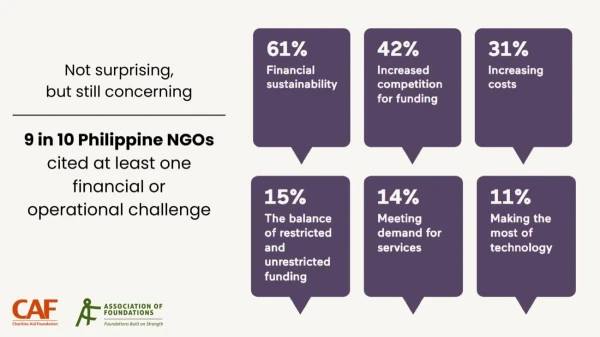
The Philippines’ nonprofit sector is buckling under the weight of escalating demand for social services, even as financial and operational constraints squeeze charities nationwide.
The Charities Aid Foundation’s World Giving Report 2026-Charity Insights reveals a sector stretched thin by geopolitical turmoil and deepening inequalities. While Filipino charities remain resilient, their ability to meet growing needs hinges on adapting to a shifting funding landscape.
“While our government is short-sighted and limited in the services that they can provide, the alternative is really civil society, community-based organizations.” — Jodel Dacara, regional coordinator for Asia and the Pacific at Worldwide Initiatives for Grantmaker Support
The Funding Paradox
Despite high public confidence in their work, Philippine NGOs are grappling with uneven income streams. While global charities often rely on public donations, 81% of Filipino organizations depend on philanthropists—including wealthy families and individual donors—for the bulk of their funding. This reliance, however, leaves them vulnerable to the whims of a small group of grantors.
The report highlights another looming threat: the Philippines’ transition to an upper middle-income country has triggered reductions in multilateral and bilateral aid. Agencies like USAID, which shuttered in 2025 under the Trump administration’s "America First" policy, were once key supporters of Philippine NGOs. Their withdrawal has forced charities to rethink their fundraising strategies.
“There’s no shortage of wealth. It’s just concentrated in the hands of a few families, corporations and countries. The question is, how do we actually make sure that [it] is distributed to those needing support?” — Jodel Dacara
A Call for Collaboration
The erosion of traditional funding sources has pushed NGOs to explore alternative approaches. Milet Aquino, communications officer for the Association of Foundations (AF), emphasizes that public trust must be nurtured through transparency and accountability—not taken for granted.
“We have to give ourselves some credit and recognize that this trust [in NGOs] is actually a strength, but also a responsibility for us to protect and nurture that trust through transparency and accountability.” — Milet Aquino, Association of Foundations
Oman Jiao, AF’s executive director, argues that competition among NGOs for limited funds is counterproductive. Instead, he urges a shift toward collaboration, where organizations pool resources and align goals to maximize impact.
“It has become very competitive [for] NGOs. When you think that everyone really just wants to help, [that] everyone deserves that kind of funding, you have to think twice already.” — Oman Jiao, Association of Foundations
Dacara echoes this sentiment, stressing that collaborative fundraising could be the key to weathering the storm. “We cannot compete with each other,” he says. “We need to partner with each other.”
As Philippine NGOs navigate this precarious landscape, their ability to adapt—whether through diversified funding, strategic partnerships, or renewed accountability—will determine whether they can continue filling the gaps left by an overstretched government.