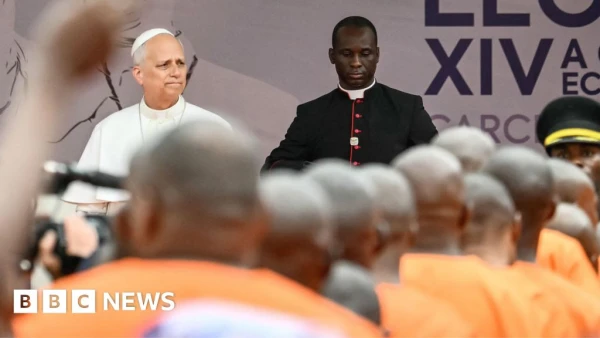
Pope Leo has sharply criticized the treatment of prisoners in Equatorial Guinea, highlighting troubling conditions as he concluded his four-nation African tour. The pontiff addressed the issue during a Mass in Mongomo on Wednesday, attended by approximately 100,000 people, including President Teodoro Obiang Nguema Mbasogo.
"My thoughts go to the poorest, to families experiencing difficulty and to prisoners who are often forced to live in troubling hygienic and sanitary conditions," Pope Leo stated.
Later that evening, he visited Bata Central Prison, a high-security facility notorious for its harsh conditions. Amnesty International has reported that inmates there face routine beatings as punishment, with many disappearing without trace, leaving families uncertain of their fate.
During his sermon at the Basilica of the Immaculate Conception, the Pope urged Equatoguineans to prioritize the common good over private interests and bridge the gap between the privileged and disadvantaged. He emphasized that the country's substantial natural resources, primarily oil, should benefit all citizens rather than a select few.
"The Creator has endowed you with great natural wealth. I urge you to work together so that it may be a blessing for all," he said, warning that the nation's future hinges on these choices.
Equatorial Guinea, despite its oil wealth, faces severe income inequality and widespread poverty. Transparency International ranks it among the world's most corrupt countries, and the World Bank reports that over half of its population lives in poverty. Political opposition is heavily restricted, and the government controls all broadcast media.
Pope Leo also called for greater freedom and the protection of human dignity, a pointed remark in a nation with a poor human rights record. His tour, which included stops in Algeria, Cameroon, and Angola, has been marked by frank commentary on governance and resource exploitation in Africa.
President Obiang, who has ruled since 1979, held a private meeting with the Pope on Tuesday. The visit underscores the Vatican's focus on Africa, the fastest-growing region for Catholicism, while drawing attention to systemic issues in one of the continent's most resource-rich yet troubled nations.