The Philippine Stock Exchange Index (PSEi) continued its downward trend on Friday, closing lower as investors weighed the central bank's latest interest rate hike and rising inflation expectations.
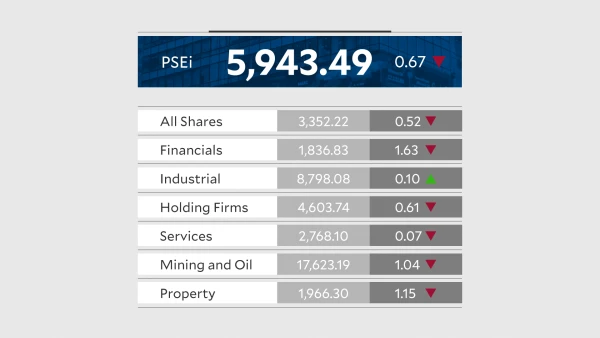
The benchmark index dropped 0.67 percent, or 40.32 points, to settle at 5,943.49. This marks the fifth consecutive session of losses for the local bourse.
Analysts attributed the decline to the Bangko Sentral ng Pilipinas' (BSP) decision to raise policy rates by 25 basis points, which prompted a reassessment of risk amid tighter financial conditions.
"The rate hike, coupled with elevated inflation forecasts, dampened market sentiment," said Japhet Tantiangco, research manager at Philstocks Financial. The BSP now projects average inflation at 6.3 percent for the year.
Adding to the pressure were a weaker peso and higher borrowing costs, which weighed on equities. Persistent uncertainty in the Middle East also kept buying interest subdued, noted Luis Limlingan, head of sales at Regina Capital Development Corp.
Trading activity was muted, with net value turnover at just P5.23 billion, below the usual levels. Foreign investors remained net sellers, posting outflows of P628.11 million.
Sector performance was broadly negative, with only the industrials index posting a slight gain of 0.1 percent. The banking sector was the worst hit, falling 1.63 percent as higher rates raised concerns about borrowing costs and loan demand.
Market breadth was weak, with decliners outpacing advancers 110 to 80.
Monde Nissin Corp. was the top gainer, rising 1.21 percent to P6.68, while Bank of the Philippine Islands was the biggest loser, sliding 3.46 percent to P92.10.
Analysts said the market remains sensitive to monetary policy signals and external risks, particularly inflation and geopolitical developments. They expect cautious trading to persist until clearer direction on interest rates and global economic conditions emerges.