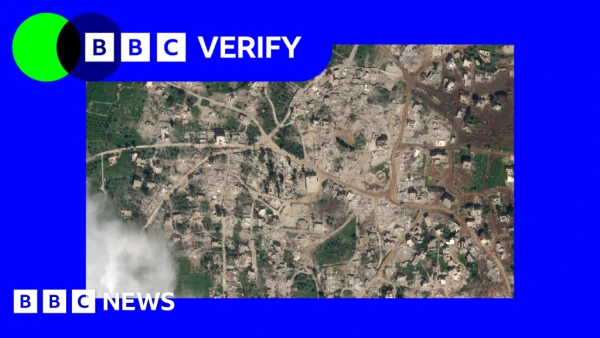
Satellite imagery and verified video analysis reveal a systematic campaign of controlled demolitions by Israeli forces that has leveled over 1,400 buildings across southern Lebanese border towns since early March, transforming once-vibrant communities into fields of dust and debris.
BBC Verify's investigation, drawing on satellite comparisons and authenticated footage, documents coordinated explosions engulfing entire neighborhoods in at least seven border communities. The town of Taybeh, just 4 kilometers from the Israeli border, has suffered particularly intense destruction, with more than 400 structures—including a mosque—reduced to rubble between late February and mid-April.
"These are not just buildings, they represent a community," said Kandice Ardiel, spokeswoman for the United Nations Interim Force in Lebanon, describing the destruction in the coastal town of Naqoura as "truly heartbreaking." Satellite analysis shows at least 100 buildings leveled there, with explosions damaging the UN peacekeeping mission's headquarters.
The demolitions follow Israeli Defense Minister Israel Katz's March 22 order to "accelerate the destruction of Lebanese homes" near the border, implementing what he described as the "model in Gaza." This strategy aims to create an Israeli-controlled "security zone" extending to the Litani River, encompassing approximately 10% of Lebanon's territory.
International law experts warn these systematic demolitions may constitute war crimes. "The bar for necessity is higher than military convenience or advantage," explained Professor Janina Dill, a global security and international law expert at Oxford University. "It certainly does not cover levelling entire villages as a predicate to long-term national security."
The Israel Defense Forces maintains it operates within the Law of Armed Conflict, stating destruction occurs only when "imperative military necessity" exists. Without providing evidence, the IDF claims Hezbollah has embedded military infrastructure within civilian areas.
Meanwhile, the humanitarian toll continues to mount. UN estimates indicate more than 1.2 million people have been displaced across Lebanon, with 820,000 fleeing southern regions. The Lebanese health ministry reports over 2,000 deaths since hostilities began, while Israeli authorities state 15 Israelis have been killed by Hezbollah in recent weeks.
As excavators and armored vehicles continue their work in villages like Aita al-Shaab—where over 460 buildings have been demolished—the landscape of southern Lebanon undergoes a fundamental transformation, with winding stone streets and sweeping valley views replaced by uniform gray expanses of destruction.