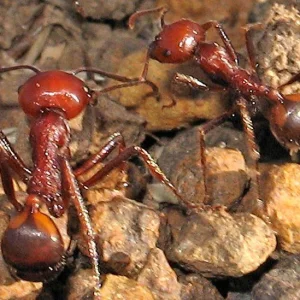
In the quiet agricultural town of Gilgil, nestled within Kenya's picturesque Rift Valley, the rainy season triggers a spectacular natural phenomenon: the mating flight of the giant African harvester ant. But this biological ritual has recently spawned a highly unusual and lucrative criminal enterprise, transforming tiny insects into globally trafficked contraband.
While East Africa has long battled high-profile wildlife syndicates smuggling elephant ivory and rhino horn, authorities are now confronting a bizarre new frontier in biopiracy. At the center of the craze is the Messor cephalotes queen. Sporting a distinctive reddish hue and capable of growing nearly an inch long, a single fertilized queen can command up to $220 on international black markets.
This sudden surge in demand is fueled by an exploding global hobbyist market. Insect enthusiasts across Europe and Asia are eager to purchase the queens for elaborate transparent habitats, where they can observe the insects constructing massive, intricate colonies from scratch.
Entomologist Dino Martins notes that the appeal lies in the species' docile nature and fascinating behaviors. However, even seasoned wildlife experts are taken aback by the sheer scale of the underground trade.
"Even I, as an entomologist, have been surprised at the extent of the apparent trade," Martins observed. He explained that these resilient foundress queens can live between 50 and 70 years, spawning sprawling subterranean empires protected by hundreds of thousands of female worker and soldier ants.
The smuggling methodology is astonishingly simple. Local residents, often unaware they are participating in an international crime, are recruited to harvest the valuable bugs.
One former broker confessed that foreign buyers rarely got their hands dirty. Instead, they would wait in local guest houses or parked cars, handing out small test tubes and syringes to locals. Villagers would then scour the fields in the early morning heat, capturing the queens as they left their mounds to mate or by gently digging them out. Because the ants are small organic matter, they easily pass undetected through standard airport security scanners. When packed with a bit of moist cotton wool, the insects can survive in transit for up to two months.
The staggering scope of this six-legged smuggling ring came to light last year when Kenyan authorities raided a guest house in the tourist hub of Naivasha. Wildlife officials rescued 5,000 live queen ants destined for Asian and European markets. The operation led to the conviction of Belgian, Vietnamese, and Kenyan nationals, who paid $7,700 in fines for biopiracy before the foreigners were deported.
Just weeks ago, the black market took another major hit. A Chinese national—believed to be the elusive mastermind behind the Naivasha ring who had previously escaped using a different passport—was apprehended at Nairobi's Jomo Kenyatta International Airport. He was caught attempting to board a flight with an astonishing 2,000 live queens concealed in tissue rolls and test tubes.
As the exotic ant-keeping hobby continues to gain traction worldwide, researchers are sounding the alarm over the environmental cost. Scientists like Zhengyang Wang warn that the mass commercial extraction of these vital seed-gathering insects could wreak unprecedented havoc on local ecosystems, proving that the removal of even the smallest creatures can leave a massive ecological footprint.