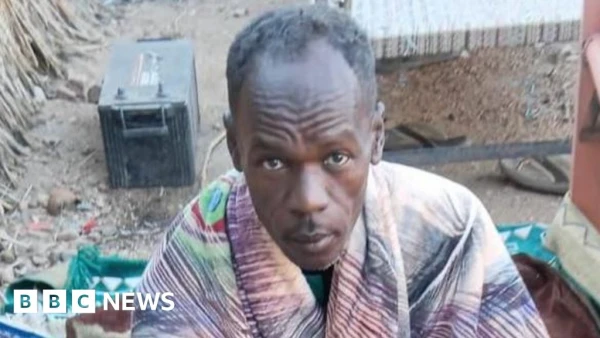
When Mohamed Suleiman finally reached a telecommunications office in Port Sudan on January 13, he broke down in tears. For nearly three years, his phone had been silent—a casualty of Sudan's brutal civil war that began on April 15, 2023, following a power struggle between the army and the Rapid Support Forces (RSF) paramilitary group.
Trapped in the western city of el-Fasher, Suleiman, a journalist and academic, had been largely cut off from the world by a communications blackout. He was unable to convey the horrors unfolding around him as the RSF laid siege to the city for 18 months.
"Throughout the past three years, my phone was silent," Suleiman recalls. "After I inserted the SIM card, my tears flowed."
When his device finally sprang to life, it flooded with three years' worth of messages—an inventory of loss. There were notifications about colleagues who had died and desperate inquiries from friends wondering if he was still alive.
"A few days ago, a person called me saying he thought I had died," he says. "Some people had told him that I was in Port Sudan, so he called me, but he didn't believe it was me until I called him back by video. Then he broke down in tears."
For Suleiman, the silence proved almost as deadly as the violence itself.
"It was a suffocating feeling because I was watching systematic killings through drone strikes and bombs or deadly killing through the tight siege," he describes.
The fall of el-Fasher in October last year marked one of the war's most brutal chapters.
"It was like the Day of Judgment on Earth," Suleiman says. "We witnessed the Day of Judgment on Earth."
As the conflict enters its fourth year, fighting has effectively partitioned Sudan between army-held and RSF-controlled territories. Millions have been displaced amid what has become the world's worst humanitarian crisis, with diplomatic efforts to end the war repeatedly failing.
Civilians in el-Fasher found themselves caught between the RSF and local armed groups assisting the army. As the paramilitaries tightened their siege, famine conditions took hold.
The daily trauma of death and hunger erupted into apocalyptic scenes as residents desperately tried to escape the advancing RSF forces.
"We saw dead children in the streets," Suleiman recounts. "We saw women crying from extreme hunger and thirst, too weak to carry their children, so they left them in the road."
Many attempted to flee to the nearest safe haven, the town of Tawila, navigating roads littered with casualties.
"There are things I cannot describe because they are inhumane," Suleiman says. "I cannot talk about them. And the regrettable thing is that the audio-visual media did not convey the scene. Until now, the world does not know what happened in el-Fasher city."
The RSF leadership has acknowledged "individual violations" during the takeover but claims these are under investigation and that atrocity reports have been exaggerated. Both sides face accusations of war crimes, including mass civilian casualties from air and drone strikes.
Communications in el-Fasher deteriorated rapidly from the war's outset due to fighting and fuel shortages that cut power. The blackout intensified when the RSF besieged the city in May 2024.
Some managed to smuggle in Starlink devices for satellite internet, but these were prohibitively expensive, restricted by the army, and confiscated by the RSF. Journalists who accessed such devices faced grave risks from both sides.
"The Rapid Support Forces consider you affiliated with security agencies and accuse you of using it for espionage," Suleiman explains. "As for the army, they consider that when shelling begins, you are accused of being a spotter."
This accusation of acting as a military spotter—someone identifying targets and communicating ground conditions—endangered many journalists and hindered truth-telling from el-Fasher.
Suleiman himself narrowly escaped death in July 2025 when a shell landed less than two meters from him as he walked home. He survived but lay on the ground for half an hour, clutching a phone that couldn't call for help.
"If I had been injured, I would have died," he says.
He watched drones fly into the city but had no means to warn others. His story stands as a testament to both the brutality of Sudan's war and the profound isolation inflicted upon those trapped within it.