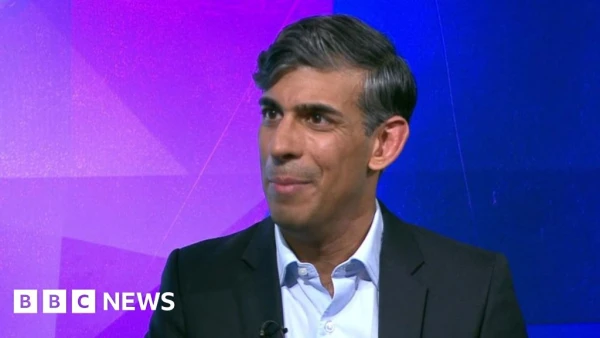
Former Prime Minister Rishi Sunak has issued a stark warning about artificial intelligence's impact on young job seekers, stating that the technology is "flattening" entry-level employment opportunities while advocating for a major tax shift to address the challenge.
Speaking to the BBC, Sunak—now an adviser to AI firm Anthropic and Microsoft—acknowledged that while he remains enthusiastic about AI's transformative potential, concerns from graduates struggling to find work are "justified." He revealed that company executives are privately admitting that youth recruitment is stagnating due to AI adoption.
"There are reasons to be worried and think about the future. But we are able to do something about this," Sunak said.
Sunak pointed to service sectors like law, accountancy, and creative industries as particularly challenging for young entrants. He quoted CEOs who now believe "flat is the new up"—meaning businesses can grow without significantly increasing employment through AI deployment.
The former chancellor proposed rebalancing the tax system by gradually eliminating National Insurance and replacing it with taxes on corporate profits, which he argued would be boosted by AI-driven productivity gains. This shift, he suggested, would make hiring workers more attractive to employers.
"We should be thinking about how we tip the balance in favour of AI being used in that positive way… to help people do their jobs better rather than replacing them," Sunak told BBC Newsnight.
Sunak warned that many countries will need to examine similar systemic rebalancing as employment taxes generate less revenue, forcing governments to find alternative funding sources. He noted that AI's employment impact "may be different to previous technology cycles."
The Conservative MP also addressed concerns about Anthropic's new AI model, Claude Mythos, which reportedly outperforms humans in some hacking and cybersecurity tasks. He argued this demonstrates why "we shouldn't rely on companies to mark their own homework," praising Britain's AI Security Institute—established during his premiership—for being first to test the model's capabilities.
Despite the challenges, Sunak expressed optimism about the UK's tech future, referencing recent multi-billion pound investments that some in the industry call "Londonmaxxing" and "Britmaxxing." He asserted that the UK is "an AI superpower any which way you look at it" with the opportunity to become the world's foremost productive user of AI, bolstered by the presence of companies like DeepMind, Anthropic, and OpenAI.
Sunak also revealed he has collaborated with Labour's deputy prime minister David Lammy to promote UK tech investment, emphasizing bipartisan support for the sector's growth even as its workforce implications raise serious questions.