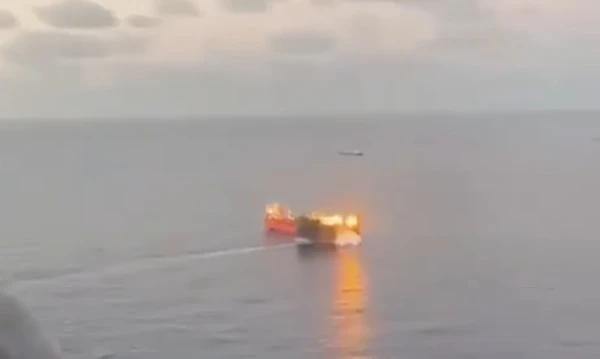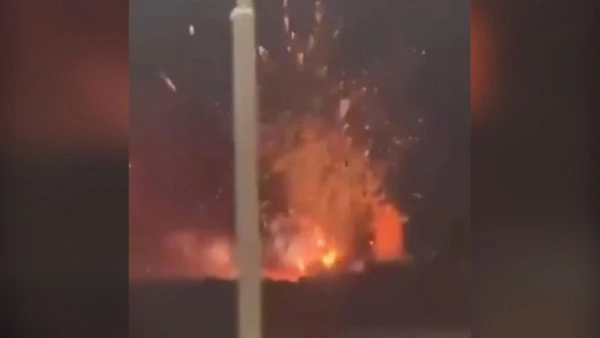
An explosion that sank a Russian naval vessel docked at the Benghazi naval base in Libya is believed to have been caused by a drone attack, according to the country's eastern government.
The blast occurred at dawn while the warship was taking on fuel and supplies during a return voyage to Russia. State media reported no casualties resulting directly from the morning incident, though the health ministry later confirmed receiving individuals with minor injuries from a separate commercial vessel targeted off the Benghazi coast.
Social media footage geolocated by analysts showed the stricken warship engulfed in thick smoke and flames. Satellite imagery and high-resolution intelligence photos subsequently revealed the vessel—identified by US-based intelligence firm Vantor as a Project 20380 Steregushchiy-class corvette—capsized and largely submerged, with only its forward bow remaining above water.
The eastern-based Government of National Stability (GNS) stated that the Russian ship was utilizing the port under an existing maritime agreement. Condemning the strike as a violation of sovereignty and maritime safety, the GNS emphasized that Libya remains neutral in the conflict between Russia and Ukraine.
Meanwhile, Libya's internationally recognized Government of National Unity (GNU) in Tripoli issued a separate warning against hosting foreign military forces, cautioning that involving local ports in external conflicts endangers civilian lives and national infrastructure. Libya has remained politically fractured since the 2011 overthrow of leader Muammar Gaddafi.
While official responsibility has not yet been claimed, security experts point toward Ukrainian operations in the region. Jalel Harchaoui, a Libya specialist at the Royal United Services Institute, noted that such an audacious operation bears the hallmark of Ukrainian forces expanding their reach against Russian assets outside the Black Sea.
Beyond the direct military impact, the strike carries geopolitical consequences for eastern Libya's leadership, particularly commander Khalifa Haftar, whose administration permitted the Russian presence. Observers suggest the breach of security within a controlled port could prompt swift local reactions as authorities investigate the origins of the attack.