Sweden is undertaking a dramatic shift in its educational approach, moving away from digital devices and championing a return to traditional tools like physical books, paper, and pens. The government's initiative, aimed at reversing declining literacy rates, is igniting a fierce national debate about the future of learning and workforce readiness.
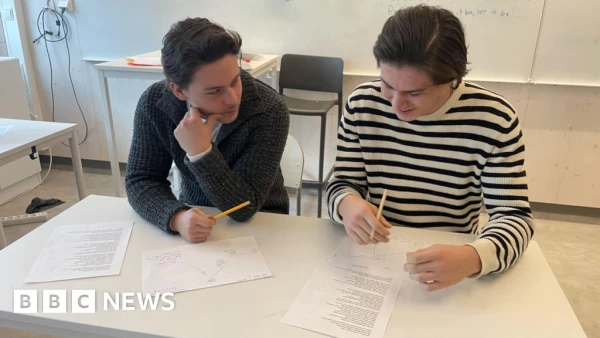
At a high school in Nacka, near Stockholm, the change is palpable. Students like 18-year-old Sophie now regularly carry home textbooks and printed materials, a contrast to recent years dominated by laptops. "One teacher has started printing all the texts we use," she notes, describing how digital math platforms have been replaced with textbooks.
This pivot marks a stark departure from Sweden's image as a digitally advanced society. The country had embraced technology in education, with laptops becoming mainstream in classrooms over a decade ago and tablets mandated in preschools by 2019. However, the current right-wing coalition, in power since 2022, is steering in the opposite direction.
"We're trying, actually, to get rid of screens as much as possible," states Joar Forsell, education spokesperson for the Liberal party, which leads the education ministry. The government's slogan, "från skärm till pärm" (from screen to binder), encapsulates its belief that screen-free lessons improve concentration and foundational skills like reading and writing.
Concrete policy changes are underway. Since 2025, preschools are no longer required to use digital tools, and tablets are withheld from children under two. A ban on mobile phones in schools—even for educational purposes—is set to take effect later this year. The government has allocated over 2.1 billion krona ($200 million) for textbooks and teacher guides, with a new textbook-focused curriculum planned for 2028.
"Reading real books and writing on real paper, and counting with real numbers on real paper, is much better if you want kids to get the knowledge they need," argues Forsell.
The policy shift follows a 2023 consultation and is backed by concerns from experts like neuroscientist Dr. Sissela Nutley, who warns of digital distractions and research suggesting screens can hinder information processing and impact young children's brain development.
The government hopes this traditional turn will boost Sweden's performance in international PISA rankings, where its scores in reading and math have seen significant declines since 2012. In 2022, nearly a quarter of 15- and 16-year-olds failed to reach a basic level of reading comprehension.
However, the move has drawn sharp criticism from tech companies, educators, and industry groups. A report from the Swedish Edtech Industry trade association warns that an analogue-heavy education risks leaving pupils unprepared for the job market. "Everybody needs digital basic skills in order to enter the workforce," says CEO Jannie Jeppesen, citing EU estimates that 90% of jobs will soon require digital competencies.
Critics also fear for Sweden's innovation economy, home to tech "unicorns" like Spotify. Jeppesen argues these companies "will move elsewhere" if they cannot find local IT talent. The debate extends to artificial intelligence (AI), with the government planning AI lessons for secondary schools but facing calls to include younger children.
Andreas Schleicher, director for education at the OECD, offers a nuanced perspective. While a recent OECD report found Swedish pupils generally benefit from digital access, it also noted high levels of classroom distraction. Schleicher suggests Sweden's previous "extreme" adoption of technology without clear pedagogical goals likely contributed to its educational challenges.
As Sweden forges ahead with its back-to-books strategy, the nation finds itself at a crossroads, balancing the pursuit of improved literacy against the demands of a digital future.