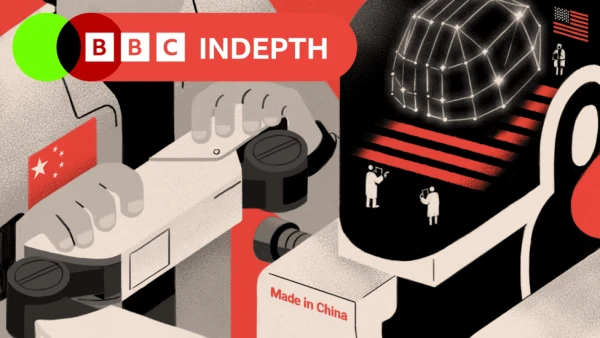
The 21st century's defining technological rivalry is unfolding between the United States and China, with artificial intelligence serving as the battlefield. Unlike the nuclear arms race of the Cold War, this trillion-dollar contest plays out in research labs, university campuses, and tech startups, with both superpowers vying for global technological dominance.
Experts frame the competition as a clash between "brains" and "bodies." The U.S. has traditionally excelled in AI "brains"—the realm of chatbots, microchips, and large language models (LLMs). China, meanwhile, has built superiority in AI "bodies," particularly in robotics and humanoid machines. However, recent developments suggest these advantages may be shifting, transforming the race in unexpected ways.
The U.S. Gambit: Controlling the Hardware
America's strategic edge has long been rooted in hardware. The most powerful computer chips, essential for training advanced AI models, are predominantly designed by U.S. companies like Nvidia and manufactured in allied territories like Taiwan. Washington enforces strict export controls to prevent these chips from reaching China, a policy intensified in 2022.
"The key to America's strategic advantage lies less in the remarkable algorithmic coding, and more in the hardware driving the immense computing power," notes a senior U.S. official.
This protectionist approach extends to blocking China's access to specialized manufacturing equipment, such as the ultraviolet printing machines made exclusively by Dutch firm ASML. For years, this strategy seemed to secure America's lead in AI "brains."
China's Surprise Countermove
In January 2025, China disrupted this narrative with the launch of DeepSeek, an AI-powered chatbot rivaling U.S. models like ChatGPT. Remarkably, DeepSeek was developed at a fraction of the cost, proving that Chinese innovators could create sophisticated LLMs despite hardware restrictions.
The launch sent shockwaves through global markets, triggering historic losses for chip giant Nvidia. Analysts suggest the U.S. export controls may have inadvertently accelerated China's self-reliance.
"It ended up accelerating China's self-reliance," observes AI journalist Karen Hao. "Chinese developers had to make do without the powerful chips, forcing them to be creative."
China's collaborative, open-source approach to AI development contrasts sharply with America's proprietary model. Chinese firms often publish their code publicly, allowing rapid iteration and improvement across the ecosystem.
"The Chinese model, maybe it's only 90% as good, but it is 10% as expensive," says researcher Selina Xu, highlighting the cost-effectiveness driving China's AI advancements.
The Robotics Frontier
While the LLM race grows more competitive, China maintains a clear lead in AI "bodies." Since the 2010s, substantial government funding and subsidies have fueled a robotics revolution, with millions of working robots now deployed across Chinese industries—more than the rest of the world combined.
This expertise in physical AI systems complements China's growing prowess in software, creating a comprehensive AI ecosystem that challenges American supremacy.
An Unpredictable Future
The AI race is no longer a simple matter of U.S. brains versus Chinese bodies. Both nations are encroaching on each other's traditional strengths, setting the stage for a complex, multi-front competition. As investments mount and innovations accelerate, the coming years will determine whether either superpower can achieve decisive dominance—or if the race will yield a new, bifurcated technological world order.